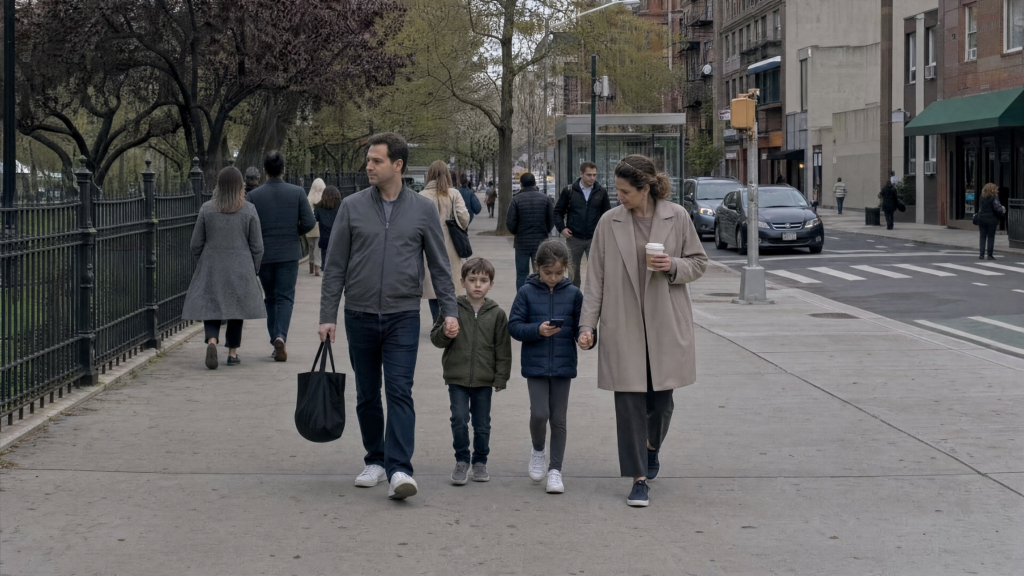
The Grey Man: How to Disappear in Plain Sight Before and After the Collapse
By the Collapse Ready Household Series Editorial Team
“The most dangerous man in any crowd is the one nobody noticed entering.”
— Anonymous OPSEC instructor
Introduction: The Force Multiplier Nobody Talks About
In the preparedness community, we spend a great deal of time talking about what we carry, what we store, and what we know. We discuss calibers, water filtration ratios, medical protocols, and bug-out routes with granular specificity. But there is one capability that multiplies the value of every other preparation you’ve made, and it receives a fraction of the attention it deserves: the ability to be utterly, functionally, operationally invisible.
The Grey Man concept is one of the most misunderstood ideas in preparedness — but when applied correctly, it becomes a force multiplier for your entire household.
Understood at a surface level, “grey man” sounds like fashion advice — wear neutral colors, ditch the tactical gear. That reading is not wrong, but it captures perhaps twenty percent of the concept. The true grey man is a practitioner of what intelligence professionals call pattern of life blending — the deliberate alignment of appearance, behavior, communication, and social presentation with the ambient expectations of whatever environment they are moving through. In normal times, this means not triggering the pattern-recognition threat assessment of surveillance systems, criminals, or data collectors. In a post-collapse environment, it means not triggering the threat assessment of desperate, armed, or organized groups who are actively cataloguing resources — including people with visible skills, supplies, or defensive capability.
This post covers the grey man concept from first principles through practical application, in both pre-collapse daily life and post-collapse urban survival. We will go deeper than clothing advice. By the end, you will understand why the grey man concept is not merely a tactical trick — it is a complete operational philosophy.
Part One: What the Grey Man Actually Is
The Core Definition
The grey man is an individual who, by deliberate design, fails to register in the threat assessment, resource assessment, or memory formation processes of those around them. In practical terms: you pass through an environment and leave no impression. Bystanders cannot accurately describe you afterward. Surveillance systems capture you but find nothing worth flagging. Opportunistic criminals look past you toward more visible targets. Authority figures see nothing that warrants attention.
This is not invisibility in the literal sense. The grey man is present — fully present, in fact, and more situationally aware than almost anyone around them. The distinction is between being seen and being noticed. The grey man is seen constantly. They are noticed by almost no one.
The concept has roots in multiple disciplines simultaneously. Intelligence professionals call it cover for action — the use of unremarkable behavior and appearance to operate without surveillance detection. Criminologists studying victimology call it low target profile — the set of characteristics that make a person statistically less likely to be selected by opportunistic offenders. Military special operations call it cultural pattern matching — the deliberate adoption of local behavioral norms to move through civilian environments without triggering anomaly detection. The grey man prepper draws from all three disciplines and synthesizes them into an everyday operational posture.
The Three Pillars of Grey Man Practice
Before diving into tactics, understand that the grey man concept operates across three simultaneous axes, and weakness in any one axis defeats the other two:
1. Visual Signature — What you look like. This includes clothing, gear, color palette, physical presentation, and the visible signals your appearance broadcasts to observers. A man in tactical pants, a plate carrier, and a molle-festooned bag sends a high-resolution signal about his capabilities, his mindset, and his probable resources. A man in plain khakis and a canvas daypack sends no signal at all.
2. Behavioral Signature — How you move, communicate, and interact. An individual who moves through a crowd with a military bearing, scans doorways and windows with obvious systematic intent, positions themselves with their back to walls, and speaks in quiet, clipped sentences is broadcasting a behavioral signature that a trained or even semi-aware observer will flag immediately — regardless of what they’re wearing. Behavior is the axis that most preppers neglect entirely.
3. Information Signature — What data you leave behind in digital, social, and interpersonal environments. This includes your social media presence, your digital purchasing history, your vehicle’s visible gear, your bumper stickers, and what you say about yourself to neighbors, coworkers, or casual acquaintances. A grey man household leaves the smallest possible external information profile about its resources, capabilities, and plans.
All three pillars must be maintained simultaneously. Failure in one creates a vulnerability that the other two cannot compensate for.
Part Two: Pre-Collapse Grey Man — Blending Into Normal Life
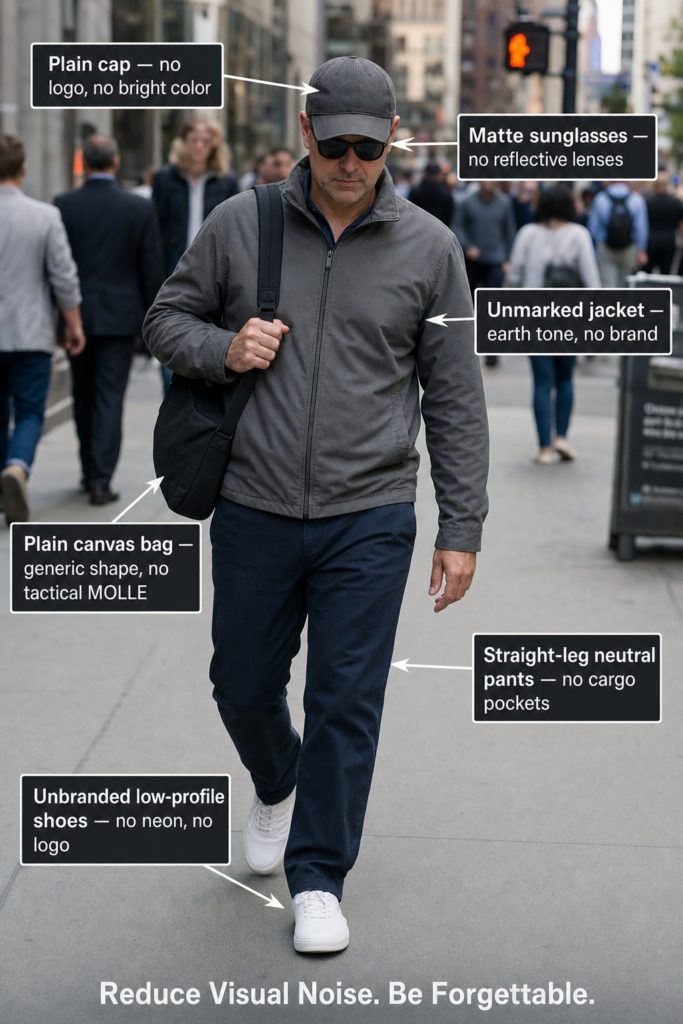
No logos, no tactical cues, no visual noise. This is the baseline pre-collapse urban grey man appearance.
Why You Need Grey Man in Normal Times
Many preppers assume the grey man concept is a post-collapse protocol — something to activate when the grid goes down. This assumption is operationally dangerous. The grey man is not a mode you switch on; it is a practice you build until it becomes default posture. More critically, the pre-collapse environment already contains multiple categories of observer who present genuine risk to a prepared household:
Opportunistic criminals operate on pattern recognition. A vehicle with a gun shop bumper sticker, visible firearms, or tactical gear on the back seat is a higher-value target than an identical vehicle with none of those signals. Home burglars specifically target houses displaying indicators of firearm ownership — because firearms are easily fenced and owners are often predictably away during work hours. The grey man household does not advertise its inventory.
Social media and data aggregators build profiles of high-net-worth preparedness households through entirely passive collection. The Amazon order history that includes water filtration systems, freeze-dried food in bulk quantities, medical trauma kits, and ammunition is a profile. The social media presence that includes gun range photos, tactical gear reviews, and preparedness community group membership is a profile. These profiles are commercially available, data-broker aggregated, and accessible to anyone willing to pay a modest subscription fee. They are also increasingly of interest to political and regulatory actors in various jurisdictions. The grey man household manages its information signature with the same deliberateness it manages its physical signature.
Neighborhood and social networks represent a more subtle risk that most preppers dramatically underestimate. The neighbor who knows you have a generator, six months of food, and an armory in your basement is not a threat in normal times. In a 72-hour power outage with no definite end date, that neighbor — and everyone they’ve told — becomes a vector for desperate resource extraction, whether politely or otherwise. The grey man household maintains friendly but informationally limited relationships with its immediate community. You are known as capable and calm, not as stocked and armed.
Pre-Collapse Clothing Strategy
The goal of grey man clothing in a pre-collapse urban environment is threefold: avoid triggering threat recognition in security-conscious observers, avoid triggering resource recognition in opportunistic observers, and avoid creating memorable visual impressions in casual observers. These three goals are served by the same underlying principles.
Color palette discipline. The human visual system is tuned to detect anomaly. Bright colors, high contrast, reflective surfaces, and visible logos are all anomalies relative to the ambient visual environment of most urban and suburban spaces. The grey man palette is constructed from the mid-range of what everyone around you is wearing — not the most colorful, not the darkest, simply mid-range. In practice, this means dark navy, medium gray, olive drab, khaki, dark brown, and muted forest green. These are not “survival colors” — they are the colors of roughly 60% of the clothing visible in any American downtown on any given weekday.
Logo and brand suppression. Brand logos serve as social signals in normal times — they communicate income, affiliation, taste, and tribal membership. In a grey man wardrobe, every brand and logo signal is a piece of information you are voluntarily broadcasting. A man in a plain hoodie reads as nobody specific. A man in a branded tactical brand hoodie reads as someone with specific interests, specific products in his possession, and a specific set of beliefs about the world. Remove the signal.
Tactical gear suppression. This is the most critical point in the pre-collapse clothing section and the one most often misapplied. The problem with visible tactical gear — cargo pants, MOLLE bags, duty belts, plate carriers, and their civilian counterparts — is not that they are inherently dangerous or foolish. The problem is that they are high-resolution identity signals. A man in tactical pants immediately broadcasts that he is interested in tactical applications. In a normal urban environment, that broadcast reaches every security camera operator, every law enforcement officer, every criminal looking for a potential gun carrier, and every nosy neighbor who notices you loading your vehicle on a Sunday morning. None of these observers need to know what you are interested in.
The grey man carries a plain canvas daypack or messenger bag. He wears straight-leg pants in neutral colors — not cargo pants, not hiking pants with zip-off legs. His footwear is functional and sturdy but reads as normal: plain leather or canvas low-top boots, minimal-branding athletic shoes in neutral colors, or standard work boots without aggressive lug patterns. Nothing in his appearance answers the question “what is this person prepared for?”
Pre-Collapse EDC: Carrying Gear While Staying Grey
This is where the grey man concept becomes genuinely sophisticated, and where most preparedness guides fail the reader. The challenge is not choosing between EDC and grey man — it is carrying a complete, capable EDC kit while maintaining a grey man visual and behavioral profile. These are not competing objectives. They require careful selection and packaging.
The concealed carry piece should be exactly that — concealed. An IWB holster under an untucked shirt or a light jacket presents no visual signature. The grey man does not print. He does not adjust or touch his firearm in public. He does not sit in ways that expose his holster. He carries a compact or full-size pistol in a quality IWB Kydex holster specifically because concealed carry is the grey man carry posture by default. Open carry is a direct contradiction of grey man principles in most urban environments — it is a deliberate, high-resolution signal of capability and intent that eliminates your anonymity instantly.
The pocket knife stays in the pocket, with the clip tucked below the waistband line if possible. A visible pocket clip — especially on a recognizable tactical blade — is a signal. A grey man knife is a quality folding blade with a discrete carry clip or no clip at all, carried in a pocket without visual indication of its presence.
The multi-tool sits in a belt case or inside the daypack, not on a visible belt attachment that reads as equipment-laden. A simple black nylon belt case for a Leatherman reads as “trades professional” in most environments — marginally visible but not alarming. Inside the bag is preferable.
The flashlight is pocket-carried (most compact tacticals fit in the front pocket easily) or in the bag’s outer pocket. A flashlight with a pocket clip reads as a pen to most observers. No branding, no aggressive bezel crown exposed.
The tourniquet is the one EDC item that presents the greatest grey man packaging challenge. The CAT or SOFTT-W in a thigh pouch or visible belt medical carrier is immediately recognizable as medical trauma equipment — and in a pre-collapse environment, that recognition creates a cascade of questions about why you’re carrying it. The grey man solution is a dedicated pocket or internal bag compartment. Several manufacturers produce purpose-built tourniquet pouches designed to be carried inside a standard bag, in a deep cargo pocket, or in an IWB ankle carrier. The tourniquet must be accessible within fifteen seconds; it does not need to be on the outside of your body to meet that standard.
The fire starter and other survival items live in the bag, never on the exterior. The grey man daypack contains everything a prepared person carries, packaged in a container that reads as a commuter or laptop bag. The exterior is plain, unbranded or minimally branded, with no MOLLE webbing, no morale patches, no carabiner-hung items, and no tactical color blocking.
Pre-Collapse Behavioral Discipline
Clothing is the easiest layer of grey man practice. Behavior is the hardest — because it requires continuous, real-time management of habits built over years.
Pace matching. The most powerful behavioral grey man technique in an urban environment is matching the ambient pace of the crowd you are moving through. A man who walks faster than the crowd reads as agitated or late. A man who walks slower reads as uncertain or surveillance-aware. A man who stops to scan corners, windows, or doorways reads as threat-assessing. The grey man walks at exactly the speed the crowd dictates — slightly below brisk, fluid, directional without appearing purposeful.
Gaze discipline. The trained eye of a security professional or experienced criminal immediately identifies threat-scanning behavior: systematic left-right-up-down scanning patterns, deliberate doorway coverage checks, extended eye contact holds that assess rather than simply notice. The grey man uses peripheral vision and natural gaze patterns — looking where normal people look (signage, storefronts, other people’s faces briefly, the ground ahead), while maintaining comprehensive environmental awareness through peripheral processing. This is a trainable skill. It requires deliberate repetition in low-stakes environments.
Reaction calibration. The grey man does not react to loud noises, sudden movements, or perceived threats with the fast, trained responses that a prepared person’s muscle memory has developed. In a crowded environment, a sudden loud bang triggers a threat-assessment turn, a hands-raise, or a crouch in trained individuals — responses that are functionally appropriate but behaviorally conspicuous. The grey man calibrates his visible reaction to match the ambient population: moderate startle, look around with mild curiosity, return to baseline. The assessment happens internally and continuously. The visible response is managed.
Communication discipline. The grey man does not discuss preparedness, firearms, political positions, or resource inventories in casual social settings. This sounds obvious until you consider how frequently the preparedness community does exactly this — at the hardware store, at the range, at the neighborhood barbecue, and in online forums connected to real identities. The grey man in conversation is relatable, warm, and generic. He is interested in other people’s concerns without revealing his own operational specifics. He is a good neighbor without being an information source.
Part Three: Post-Collapse Grey Man — Invisible in a Crisis
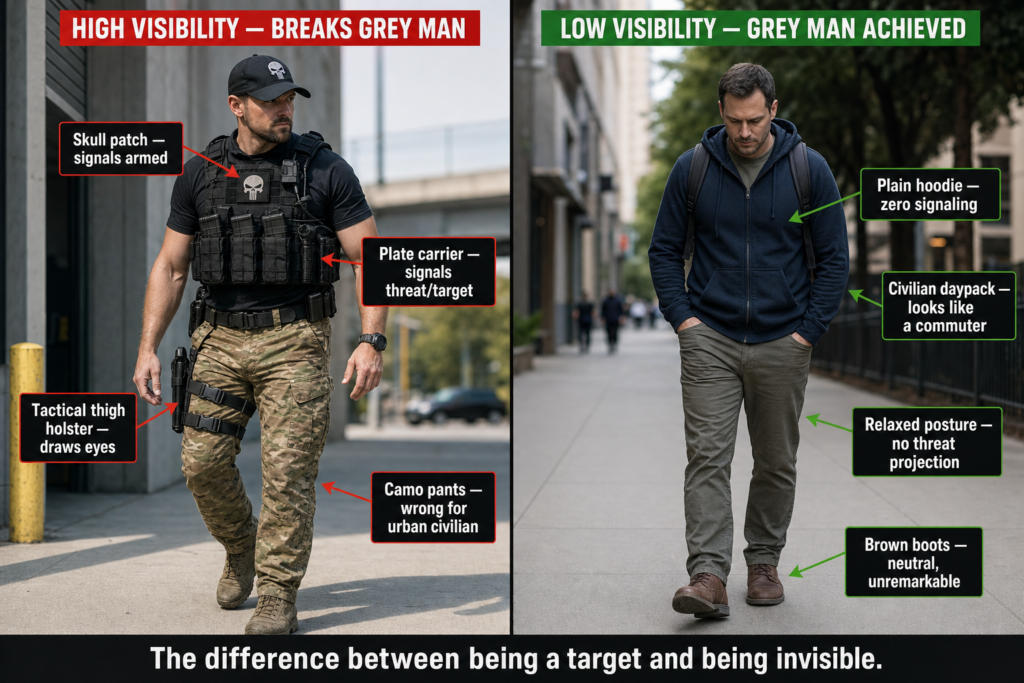
The critical distinction between high-visibility tactical presentation (left) and grey man civilian blending (right).
The Post-Collapse Threat Landscape
The post-collapse environment changes the grey man calculus in significant and specific ways. The ambient population becomes dramatically more threat-assessing than it is in normal times. Every observer — from the neighbor at the end of the block to the organized group controlling a key intersection — is now performing explicit resource and capability assessments of every person they encounter. The question has shifted from “who is this person?” to “what does this person have, and can I take it?”
In this environment, the grey man faces a more demanding challenge than in normal times, because the baseline appearance of the ambient population shifts rapidly. Within 48–72 hours of a serious collapse event, most of the population begins visibly signaling their distress — through agitated body language, emotional facial expressions, conspicuous carrying of supplies, and clustering into visible family or group configurations.
The grey man must recalibrate to this new baseline constantly, because his goal is always to match the ambient expectation, not to maintain a static appearance. There are three primary threat categories in the post-collapse urban environment that grey man practice directly addresses:
Opportunistic individuals and small groups — the majority of post-collapse threat actors in the first 2–4 weeks. These are ordinary people who have run out of resources and are now making desperate decisions. They are not organized, not particularly skilled, but they are numerous and their threat assessment is simple: does this person have something I need, and do they present a manageable level of resistance? The grey man presents nothing worth taking and an unclear resistance profile.
Organized looter groups — a smaller but significantly more dangerous category that typically emerges in the 1–4 week window of extended collapse. These groups operate with more sophisticated threat assessment and resource cataloguing. They identify houses with lights when the grid is down, vehicles that suggest fuel reserves, and individuals whose bearing or equipment suggests they possess valuable goods or skills. The grey man household manages its light signature (blackout curtains, no exterior lighting that can be seen from a distance), vehicle signature (nondescript vehicles with nothing visible inside), and individual appearance when moving through the urban environment.
Authority and checkpoint structures — the most unpredictable post-collapse threat category, which can range from legitimately beneficial to genuinely dangerous depending on jurisdiction, mandate, and personnel quality. National Guard checkpoints operating under legitimate emergency management mandates are a different threat profile than improvised local checkpoint structures operated by self-appointed groups. In both cases, the grey man presents exactly the same profile: cooperative, unremarkable, with no visible excess resources and no behavioral signals of elevated capability or concealed material.
Post-Collapse Appearance Calibration
The most important post-collapse grey man principle is this: match the visible condition of the average person in your immediate environment. In normal times, that average person is well-fed, clean, and comfortably dressed. In a 10-day collapse event, that average person is increasingly disheveled, stressed in appearance, and carrying less rather than more.
The appearance of moderate distress is an uncomfortable but important grey man tool in the post-collapse environment. A person who appears clean, well-rested, and comfortable while everyone around them appears stressed and resource-depleted is an anomaly. Anomalies are noticed. Noticed people are assessed. Assessed people with apparent resources become targets. The grey man allows his appearance to drift toward the ambient population standard — not to the point of genuine degradation, but to the point of plausible peer-level distress.
Clothing calibration for a collapsed environment shifts from the pre-collapse neutral-urban palette toward something more explicitly unremarkable given the context. In a post-collapse urban environment, plain work clothes, worn (not new) outerwear, and standard footwear are the visual baseline. The grey man’s post-collapse wardrobe is deliberately worn-looking — not filthy, not damaged, but not obviously clean and new. Pre-washing and slightly distressing key outerwear items for a post-collapse wardrobe is a legitimate pre-positioning step.
Bag and carry calibration in the post-collapse environment demands even more deliberate packaging than in normal times. A bag that reads as expensive or well-stocked is a resource advertisement. The grey man in a post-collapse environment carries supplies in the most generic container available — a plain canvas market bag, a basic school backpack, or a reused grocery bag — with no external indication of contents. His actual EDC kit is compartmentalized inside this container, not visible through mesh panels, not indicated by external tool loops or attachment points.
The false poverty principle is one of the most advanced grey man post-collapse techniques. This involves the deliberate use of decoy materials to reinforce an appearance of resource-limited status. A few visible but low-value items — a half-empty water bottle, a snack item, a worn but obviously not new piece of clothing — suggest an accurate picture of a person who has enough to get by but nothing worth taking. The grey man manages what is visible about his situation with the same care that a poker player manages the information available to opponents about his hand.
Post-Collapse Movement and Route Discipline
Physical movement through a post-collapse urban environment requires a completely different operational framework than pre-collapse navigation. The grey man plans his movements on the following principles:
Pattern of life avoidance. In a monitored or surveilled environment, predictable pattern of life creates vulnerability. The grey man does not leave the house at the same time, by the same route, every day. He varies departure times, routes, and destination approaches. He pre-identifies multiple routes between every frequently traveled origin-destination pair — home to water source, home to community resource point, home to predetermined rally point — and rotates them on an irregular schedule.
Movement timing. The grey man moves during the ambient busy periods of whatever environment he is navigating, not at times that create isolation vulnerability. In the first few weeks of a collapse event, movement during daylight hours in the company of a family member or trusted partner reduces target selection risk dramatically. Solo movement at night — unless tactically necessary — maximizes both threat exposure and target selection appeal.
Contact management. When the grey man does make contact with individuals or groups while moving, the interaction follows a specific template: cooperative and mild, with information management. He acknowledges the contact, responds with generic and unprovable claims about his situation (“just headed back home, tough day out there”), and disengages as soon as socially possible without triggering suspicion by appearing evasive. He does not advertise his origin, destination, group size, or resource level to any unknown party — ever.
Part Four: The Gear Behind the Grey Man
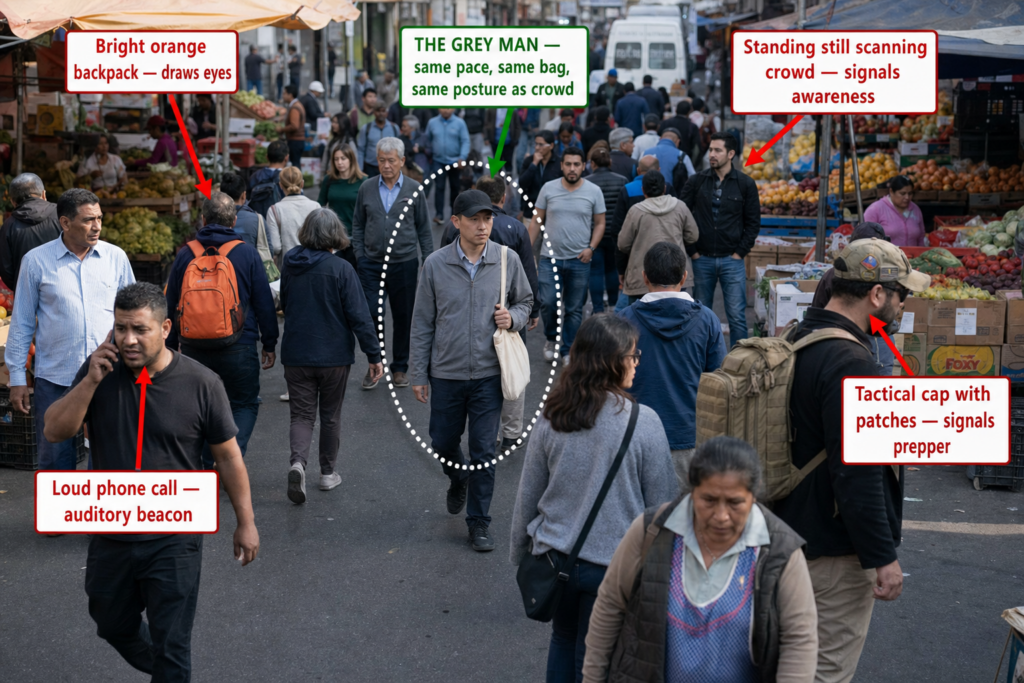
The grey man — circled in white — matches the crowd’s exact pace, carries a generic canvas bag, and keeps his gaze natural and mobile. Everyone else triggers at least one visibility flag: bright backpack, phone in use, tactical cap, or stationary scanning posture. The grey man is functionally invisible.
Building the Grey Man EDC Kit
A complete grey man EDC is a highly capable preparedness kit packaged into an appearance that generates zero interest. This requires deliberate item selection and packaging discipline across every component.
The grey man bag. The container is the first and most important packaging decision. Recommended options: a plain canvas tote in olive, navy, or gray (ideal for market environments, no tactical associations); a plain black or gray nylon daypack from a non-tactical brand (North Face, REI, or unbranded equivalents) with no external MOLLE, patches, or attachment points; or a generic leather messenger bag for professional urban environments. The interior organization is the grey man’s business — the exterior is the public’s view. Internal organization can be as sophisticated as needed: dedicated medical compartment, tool layer, hydration layer, communication layer. The exterior presents as a commuter’s bag.
Concealed firearm carry. As discussed in the pre-collapse section, IWB concealed carry is the grey man firearm posture in all but the most extreme post-collapse environments. The one post-collapse exception is an environment where open carry has become the ambient population norm — in which case concealed carry makes the grey man an anomaly in the other direction. The principle is always ambient matching. In a post-collapse scenario where most capable adults are visibly armed (a condition that typically emerges 2–4 weeks into a serious collapse), the grey man evaluates whether visible carry is required to match ambient norms, while carrying nothing more conspicuous than what the average local armed civilian carries.
Grey man medical kit. The complete trauma kit lives in the bag, packaged in a plain black or olive nylon pouch without medical crosses or “IFAK” labeling. The tourniquet — as noted in the EDC section — is carried in an internal pocket or inside the plain pouch, not in an external thigh mount. This internal carry requires a faster deployment drill, which must be practiced until it is as fast as external carry. A stopwatch and a training tourniquet resolve this: practice internal deployment until you are consistently under 20 seconds with one hand.
Hydration. A plain insulated water bottle (Nalgene, generic stainless, or similar) in a standard color. Not a branded hydration system with tubes, valves, and tactical attachment loops. The grey man’s water source is concealed in a standard consumer container.
Communication. A grey man household uses communication tools that read as consumer electronics rather than tactical equipment. A standard smartphone with privacy-conscious apps (Signal for communications, Organic Maps for offline navigation) carries more grey man utility than a GMRS radio mounted on a shoulder strap. For inter-household communication when cell infrastructure is compromised, handheld GMRS or FRS radios are stored inside the bag, not clipped to the shoulder. No antenna visible. No tactical radio aesthetics.
Navigation. Pre-downloaded offline maps on a smartphone. A laminated paper map of the immediate urban area stored in the bag without visible external indication. The grey man does not navigate with a physical map open in the middle of a public space — he navigates with internalized knowledge and brief, private phone reference.
Part Five: The Psychology of Being Grey
The Mindset Behind the Method
The grey man is not paranoid. Paranoia is a psychological state that produces erratic, hypervigilant behavior — exactly the kind of behavioral signature the grey man works to suppress. The grey man is calibrated. He maintains a continuous, low-intensity awareness of his environment that does not manifest as visible anxiety, aggressive scanning, or behavioral tension. This is a genuine psychological discipline, not a pose.
The foundational mental model is relaxed readiness — a state in which the body and nervous system are at rest but the observational and analytical systems are fully active. Think of it as the difference between a sleeping cat and an unconscious person: the cat is at rest, but its peripheral threat assessment is fully operational. A sudden movement in the periphery produces an immediate, calibrated response — not a panic, not a freeze, but a smooth transition to full readiness. The grey man’s nervous system operates in this mode continuously.
Building this state requires deliberate practice in two areas. First, meditation and attentional control — the ability to maintain background observational awareness while performing foreground tasks. Even five minutes of daily mindfulness practice measurably improves peripheral attention and reduces the reactive startle responses that create visible behavioral anomalies under stress. Second, environmental familiarization — the practice of systematically learning the normal patterns of frequently traveled environments so that anomalies register automatically. The grey man who knows what his neighborhood looks like at 7 AM on a Tuesday will immediately notice the unfamiliar vehicle, the new face at the corner, or the house with the curtains drawn for the first time in two weeks.
Situational Awareness Without Looking Aware
The Cooper Color Code is useful as a framework for understanding alertness states, but the grey man adapts it for social concealment purposes. The standard framework describes Condition White (unaware), Yellow (relaxed alert), Orange (specific threat focused), and Red (engaged). The grey man operates in a modified Yellow that is socially invisible — his alertness is genuine but his behavioral presentation is calibrated to read as the relaxed White state that most of the ambient population occupies.
The practical techniques for this social concealment of awareness are:
Reflective surface scanning. Shop windows, vehicle mirrors, polished metal surfaces, and phone screens provide full peripheral coverage of a 360-degree environment without requiring the head-turn movements that signal active threat scanning. The grey man shops windows on both sides of a street simultaneously, using each as a mirror for the environment behind him. This is not a spy movie technique — it is a learnable, natural-looking navigation habit that becomes automatic with practice.
Staged stopping. When the grey man needs to stop and assess an environment — a new street intersection, a crowd transition point, a checkpoint he wants to evaluate before approaching — he stages the stop as a natural behavior: looking at a phone, adjusting a bag strap, checking a storefront sign. The stop provides full assessment time. The staging makes it unremarkable.
Social camouflage through engagement. The grey man uses brief, low-information social interactions as cover for environmental assessment. While speaking with a vendor, shaking a neighbor’s hand, or ordering at a counter, his peripheral field is completing a full environment scan that would be conspicuous if performed while standing still and alone. Social interaction is the best cover for observation that human social norms provide.
The Social Camouflage Layer
Beyond physical appearance and individual behavior, the grey man manages his social positioning within communities — both his established pre-collapse community and any community structures that emerge post-collapse.
The grey man is useful but not indispensable. He possesses and applies skills that make him a valued member of whatever community he is part of, without advertising the full depth of his capability or resources. He helps a neighbor fix a fence without revealing that he has three months of lumber in his garage. He provides medical first aid during a block emergency without revealing that he has a complete trauma kit. He is the person the community values without being the person the community specifically identifies as resource-wealthy.
This balance requires active management. If you are known as the neighborhood problem-solver, your neighbors will come to you in a crisis. That is partially desirable — community relationships provide genuine security benefits — but it must be managed so that the flow of information does not advertise your total inventory. The grey man household’s community relationships are deliberately maintained at a level that provides mutual aid without creating a detailed external record of their capabilities.
Part Six: Common Mistakes That Break the Grey Man Illusion
Mistake 1: Over-Applying Tactical Aesthetics
This is the most prevalent grey man failure in the preparedness community, and it flows from a genuine misunderstanding of the relationship between capability and appearance. Tactical gear looks capable because it is designed to signal capability to teammates and commanders. That signaling is a feature in a military context and a catastrophic liability in a grey man context. The man who wears his tactical pants, his rigger’s belt, his MOLLE bag, and his skull-patch cap to the grocery store is broadcasting his operational interests to every camera system, every law enforcement officer, every opportunistic criminal, and every neighbor he passes. He is the least grey man in every environment he enters, despite thinking of himself as a prepared individual.
The fix is deliberate wardrobe compartmentalization. Tactical gear lives at home, in the vehicle, or in the bug-out bag — never on the body during routine urban operations. The grey man’s field capabilities are fully available inside the plain daypack. They do not require announcement.
Mistake 2: The Loudmouth Prepper Problem
Extensive knowledge is a preparedness asset. Talking about that knowledge in detail, with people outside your trusted inner circle, is a direct grey man violation. The preparedness community is culturally oriented toward information sharing — which is valuable within the community but dangerous when it bleeds into casual social settings. The neighbor who knows you have a year’s worth of food does not need to be a criminal to represent a threat. They only need to be desperate and talkative when someone more dangerous is listening.
The grey man’s social rule is simple: the volume of information you share about your resources and capabilities is inversely proportional to how much control you would have if that information spread. Share nothing about your food inventory. Share nothing about your firearm inventory. Share skills selectively. Share community-beneficial knowledge freely. Know the difference.
Mistake 3: Vehicle Signature Failures
The grey man’s vehicle is an extension of his grey man posture, and it is one of the most frequently neglected surfaces. A pickup truck with NRA decals, a “Molon Labe” sticker, a firearm brand window logo, and a visible rifle case in the bed is an advertisement. It tells every observer who passes it: this vehicle belongs to a gun owner with specific beliefs, who probably has firearms and related equipment stored at their residence or in this vehicle. In normal times, that advertisement reaches thieves. In a post-collapse environment, it reaches everyone.
The grey man vehicle has no decals, no stickers, and no visible indicators of political or preparedness affiliation. If it is a truck or SUV — the natural vehicle of the prepared household — it is clean, unremarkable in color (silver, white, gray, dark blue), and carries nothing visible through the windows that indicates special resources or capability. A gun safe bolted to the truck bed defeats the advertising purpose of a visible rifle case while maintaining access.
Mistake 4: Digital Signature Failures
The grey man’s most penetrating vulnerability in the modern pre-collapse environment is his digital footprint. Amazon purchase history, Google search history, social media group memberships, gun forum usernames tied to real email addresses, GPS location history, and smart home device usage patterns collectively constitute a detailed operational profile of a prepared household that is more complete than any physical surveillance could produce.
The fix is not paranoia — it is hygiene. Use separate email accounts for preparedness-related purchases. Use a VPN and privacy-respecting search tools for research. Do not link your social media identity to preparedness forum accounts. Manage your Amazon purchase history visibility. These are not extreme measures; they are the same data hygiene practices that any privacy-conscious individual applies. The grey man household simply applies them with more deliberateness than average.
Mistake 5: Behavioral Inconsistency Under Stress
The hardest grey man failure to guard against is the stress response that breaks the behavioral posture at exactly the moment it matters most. A person who maintains grey man appearance and behavior flawlessly in normal times will face the strongest test when a genuine threat event begins to unfold — because the trained response to threat is to go into operational mode, which looks nothing like a grey man in a crowd.
The solution is stress inoculation training: deliberate exposure to controlled stress scenarios in which the grey man posture must be maintained rather than abandoned. Force-on-force training exercises that include a social concealment component, urban navigation drills under observation, and scenario-based rehearsals of checkpoint and contact situations all build the muscle memory that makes grey man behavior the automatic stress response rather than the override.
Part Seven: The Grey Man Household — A Family System
Extending Grey Man Practice to Your Entire Household
Everything discussed in this article applies to individuals, but the collapse-ready household is a family system — and every member of that system either contributes to or compromises the household grey man profile. Children who mention the family’s food storage to classmates, spouses who discuss the family’s preparedness setup with friends, teenagers with social media presences that tag locations and display gear — all of these represent grey man vulnerabilities that require household-level management.
The approach is not secrecy enforcement through authority — it is shared understanding. Household members who understand why the grey man posture protects the family are far more likely to maintain it voluntarily than those who are simply told not to talk about certain things. Invest in family-level preparedness education that includes the grey man concept as a component of household security, not as a paranoid restriction.
For younger children, the grey man conversation is simple: we don’t talk about what we have at home with people outside our family, the same way we don’t talk about how much money mom and dad make. This is not deception — it is appropriate privacy, and children understand privacy as a concept once it is explained in age-appropriate terms.
For teenagers, the social media component deserves specific, direct discussion. A teenager’s Instagram, TikTok, or Snapchat presence that displays the family’s preparedness gear, their home location, their vehicle, or their recreational shooting activities is a grey man failure at the household level. This is a genuine conversation, not a prohibition — most teenagers, when they understand the specific risks, will make reasonable adjustments voluntarily.
For adult household members, the investment in shared training is the most durable fix. Couples who train together — at the range, in first aid courses, in preparedness scenario exercises — develop a shared operational language that includes the grey man concept naturally. The grey man household is not one prepared person and a group of dependents; it is a team with a shared operational posture.
Conclusion: The Art of Being Nobody
The grey man is not a role you play occasionally when the situation seems to demand it. It is an operational identity — a practiced, habitual, gradually refined way of moving through the world that reduces your household’s vulnerability across every scenario axis simultaneously.
In pre-collapse normal life, the grey man habit protects your family from opportunistic crime, data aggregation, and unnecessary social friction about your preparedness choices. In a transition or crisis event, it keeps you off the threat radar of every actor — individual, organized, or official — who might identify your household as a resource worth extracting. In a serious or extended collapse, it is a primary survival tool that multiplies the value of every other preparation you’ve made.
The investment required is not primarily financial. It is attentional, habitual, and psychological. The grey man spends less on visible gear than the average prepper, not more. He invests that saved attention into behavioral practice, environmental familiarization, and the quiet, patient cultivation of an unremarkable presence that no one remembers after he has passed through.
Be capable. Be prepared. Be forgotten.
Grey Man Quick-Reference Checklist
Daily Carry — Pre-Collapse
- [ ] Plain-color, logo-free clothing in neutral palette
- [ ] No visible tactical gear on the body
- [ ] EDC kit fully contained in plain, unremarkable bag
- [ ] Firearm concealed (IWB), no printing, no adjustment in public
- [ ] Tourniquet in internal pouch, not on external mount
- [ ] No preparedness-signaling stickers or patches visible
Vehicle
- [ ] No decals, no bumper stickers, no visible gear in passenger area
- [ ] Neutral vehicle color (silver, gray, white, dark blue)
- [ ] Firearms stored in locked, non-visible location
Digital
- [ ] Separate purchasing accounts for preparedness gear
- [ ] Social media disconnected from preparedness community usernames
- [ ] Location sharing disabled on non-essential applications
Post-Collapse
- [ ] Appearance calibrated to ambient population condition
- [ ] Movement varied — no predictable pattern of life
- [ ] Nothing visible that implies resource excess
- [ ] Light and noise signature managed at home
- [ ] Contact information management protocol active with all household members
A Final Word
The grey man is, at his core, a student of human attention. He understands how people see, what they notice, and why they remember. He applies that understanding not to manipulate but to protect — to move through whatever environment he faces with his family’s safety maximized and his household’s vulnerabilities minimized.
In a world that increasingly monetizes visibility — that rewards the loudest, most visible, most branded presence — the grey man chooses a fundamentally different strategy. He chooses depth over display, capability over appearance, and quiet competence over tribal signaling.
It is, in many ways, the most counterintuitive thing a prepared person can do. And in a collapse scenario, it may be the most important thing they do.
Stay Low-Profile. Stay Ready.
The grey man concept is one of the most misunderstood ideas in preparedness — but when applied correctly, it becomes a force multiplier for your entire household.
If you want more skills that are calm, capable, and field-tested, the Collapse Ready Household Series is your next step. Each manual in the series is built on the same principle this article represents: deep analysis, practical application, and the kind of field-tested reasoning that holds up when the situation gets real.
Subscribe for updates and get new manuals, articles, and SOPs as they release.
— When Systems Fail, We Don’t.