The Complete Guide to Two-Way Radio Comms: Bands, Types, and the Baofeng’s That Get the Job Done
I’ve spent a long time depending on radios for things that actually mattered — coordinating movement under fire, calling in a medevac, keeping a convoy synced across bad terrain with worse weather. When I came home and started building out the Collapse Ready system, comms was one of the first things I dug into, because here’s the truth nobody wants to say out loud: when the grid goes down, your phone is a paperweight. Cell towers need power and backhaul. The internet needs both of those plus a dozen other things working perfectly. Radio needs a charged battery and a clear line of sight — or in some cases, not even that. If you take away one thing from this article, take this: comms planning is not optional prepping, it’s foundational prepping.
Food, water, and shelter keep you alive. Communication keeps your group alive together, which is a different and often more urgent problem.
This piece is bigger than a gear review. I want to walk you through how two-way radio actually works, what the different license classes and radio types mean for your household plan, and then get specific about a lineup of radios I’ve put real hours behind — the Baofeng UV-5, UV-5R, DM-32, and AR-152 — with pricing, strengths, weaknesses, and a basic how-to for each. By the end you should understand not just “which radio to buy” but “why that radio, for that job, on that frequency.”
Why Radio Beats Every Other Comms Plan When Systems Fail
Let’s start with first principles. In a grid-down, infrastructure-degraded, or actively hostile scenario, your communication options collapse in a predictable order. Cell networks go first — either from power loss at the tower, network congestion as everyone tries to call everyone, or deliberate shutdown. Landlines increasingly ride on the same fiber and VoIP backbones as everything else, so they’re not the fallback they used to be. Satellite messengers (Garmin inReach, Zoleo, etc.) are excellent but expensive per-unit and per-message, and they’re a one-to-one or one-to-monitoring-center tool, not a group coordination tool. That leaves radio — specifically license-based two-way radio — as the only comms medium that is (a) infrastructure-independent, (b) capable of true group/net communication, and (c) affordable enough to equip an entire household or team. That’s the whole case for why every book in this series and every kit I build starts with radio.
Understanding the Alphabet Soup: FRS, GMRS, MURS, CB, and Ham
Before you buy anything, you need to know what you’re actually buying into, because the U.S. splits radio services by frequency band and license requirement, and mixing them up will either get you fined or get you a radio that can’t talk to the person standing next to you.
FRS (Family Radio Service) is the blister-pack walkie-talkie band — no license required, low power (typically 2 watts or less), and short range (realistically a half-mile to two miles depending on terrain). It’s fine for keeping track of kids at a campsite. It is not a serious preparedness tool on its own.
GMRS (General Mobile Radio Service) shares frequencies with FRS but allows higher power (up to 50 watts on some channels), repeater access, and better range — and it requires a license, though notably no test, just a fee and an application (currently around $35, good for 10 years, and it covers your whole immediate family under one license). GMRS is a genuinely good option for a household plan because it’s simple to license and the hardware (including higher-power mobile and base units) scales up nicely.
MURS (Multi-Use Radio Service) is a smaller, less-known VHF band, license-free, capped at 2 watts, that’s popular with some prepper and land-management communities because it’s quieter — fewer people know about it or use it, which has its own operational security value.
CB (Citizens Band) is the old standby — license-free, low power, famous for long-distance “skip” propagation under the right atmospheric conditions, but crowded, noisy, and generally lower audio quality. Still valuable for vehicle-to-vehicle convoy comms and it’s a good backup layer precisely because it requires zero paperwork.
Amateur Radio (Ham) is the big one — this is where the Baofeng lineup lives. Ham radio requires an FCC license (the entry-level Technician license involves a manageable multiple-choice test you can study for in a weekend), but in exchange you get access to a huge swath of spectrum, much higher power limits, repeater networks that can extend your range from miles to potentially hundreds of miles, and — critically for a collapse scenario — a massive body of community knowledge, emergency-net infrastructure (ARES, RACES), and hardware ecosystem. This is why I keep coming back to it as the backbone of a serious household comms plan, and it’s why nearly every radio in this article is a ham-band handheld. Get your Technician license. It is genuinely one of the highest-value weekends you can spend on this hobby-turned-lifeline.
Analog vs. Digital: What DMR Actually Changes
Most cheap handhelds — including three of the four radios below — operate in plain analog FM, the same technology radio has used for a century. It’s simple, universally compatible, and dead reliable. But there’s a growing digital layer worth understanding: DMR (Digital Mobile Radio). DMR converts your voice to a digital signal, which gives you clearer audio in marginal-signal conditions, the ability to fit two conversations into the bandwidth of one analog channel (via “time slots”), built-in encryption-adjacent features like individual/group calling, and often GPS location data riding along with the transmission. The tradeoff is complexity — DMR requires you to program “codeplugs” with talkgroups and color codes rather than just punching in a frequency, and it only talks cleanly to other DMR radios. My rule of thumb: analog for your baseline household fleet because everyone needs to be able to use it under stress without a manual, and DMR as a specialized upgrade layer for whoever’s coordinating a wider network.
Antennas, Range, and the Lie of “Miles of Range”
One thing that burns new preppers every time: the box says “up to 30 miles” and in practice you get two, maybe three, on flat open ground with a stock antenna. Radio range is governed by line-of-sight and terrain far more than by the radio’s wattage. A 5-watt handheld with a good antenna on a hilltop will out-communicate a 50-watt radio in a wooded valley. The single highest-value upgrade you can make to any handheld in this article is swapping the stock “rubber duck” antenna for an aftermarket unit (Nagoya and Signal Stick are both well-regarded in the community) — it’s a $15–$25 fix that meaningfully improves both transmit range and receive sensitivity. After that, elevation matters more than money: a radio held at head height on a rooftop or ridge will outperform the same radio at ground level in brush every time.
The Radios: A Practical Lineup
With all of that framing in place, here’s where the Baofeng lineup fits into a real household plan. I’m covering four models I’ve actually used — the UV-5, UV-5R, DM-32, and AR-152 — because between them they cover the beginner tier, the workhorse tier, the digital tier, and the ruggedized tier.
The Baofeng UV-5
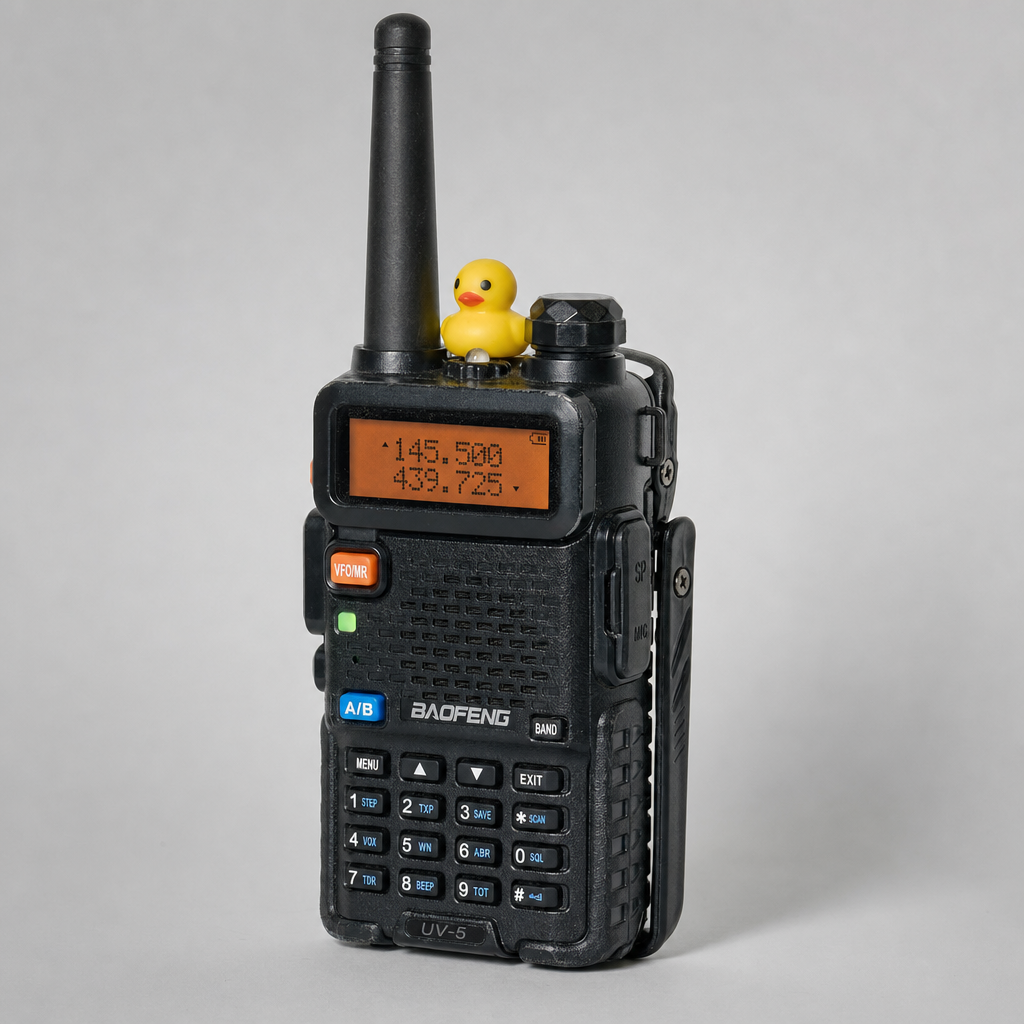
The UV-5 is the granddaddy — the radio that started the whole “cheap Chinese dual-band” movement Baofeng basically owns now. You’ll see it marketed under a dozen names and sub-variants, and honestly, most of what’s sold today as a “UV-5” is either old-stock or a rebadge of the UV-5R’s earlier hardware.
Price: typically $18–$25. That’s the number that matters for stockpiling — at that price, buying one for every adult in your household isn’t a decision, it’s a Tuesday.
Strengths: cheap, forgiving to learn on, and it fits the same accessory ecosystem (speaker mics, antennas, programming cables) as everything else in the lineup.
Weaknesses: older units can have sloppier receive sensitivity, the stock antenna is mediocre, and battery life on the base 1500mAh pack is the weakest in this lineup. Think of it as the “learn on this one” radio, not the “bet your life on this one” radio.
How-To — UV-5 Basics: Power on with the volume knob (top-left, turn clockwise). Use the VFO/MR button to toggle between frequency mode and channel memory mode. To manually set a frequency, punch it into the keypad and confirm. Press and hold PTT (the big side button) to transmit, release to listen. To save a frequency into memory, dial it in, hit MENU, scroll to CH-SVE (“Channel Store”), pick a channel number, and confirm. For programming dozens of channels at once — which you’ll want for a real household plan — don’t do it by hand. Get a $10 programming cable and use free CHIRP software on a laptop.
The Baofeng UV-5R
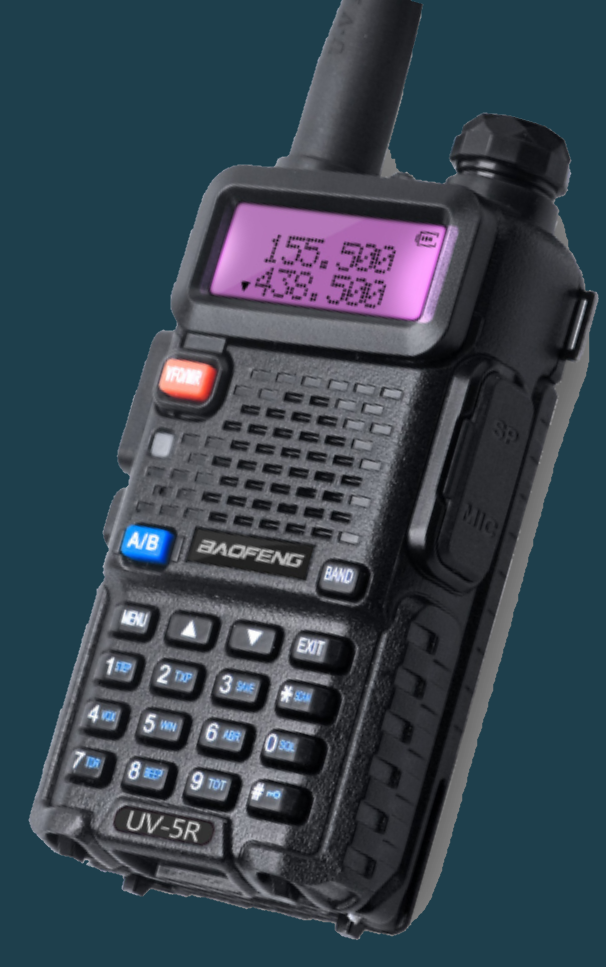
This is the one. If your household owns exactly one type of radio, it’s probably this one, and if you’re just starting your COMMS kit, this is where I tell you to start.
Price: typically $23–$30 for the standard version, a bit more for kitted versions with an extended battery, programming cable, and better antenna bundled in. The UV-5R is dual-band (VHF 136–174MHz and UHF 400–520MHz), puts out a real-world 4–5 watts, has 128 programmable channels, and comes with a genuinely deep aftermarket.
Strengths: proven reliability across millions of units sold, huge community troubleshooting base, and wide receive coverage for situational awareness (NOAA weather, and other traffic depending on what your radio can monitor — transmitting outside your licensed bands is a legal line you need to understand and respect).
Weaknesses: the menu system is genuinely counterintuitive for a first-timer, stock antenna range is short (upgrade this immediately), and the plastic battery contacts wear out faster than the radio itself does.
How-To — UV-5R Basics: Power-on and PTT behavior match the UV-5. The key added skill here is squelch and scanning. Press MENU, navigate to SQL (squelch level), and set it to 1 or 2 — too high and you’ll miss weak signals, too low and you’ll get constant static. Hold the star key to start a scan across your programmed channels. For a basic family plan: program Channel 1 as your primary simplex frequency, Channel 2 as a backup/alternate, and Channel 3 as a NOAA weather channel via CHIRP. Practice the radio-check discipline with your family now — call sign, status, out — because fumbling that under real stress is how people miss each other entirely.
The Baofeng DM-32 (DMR)
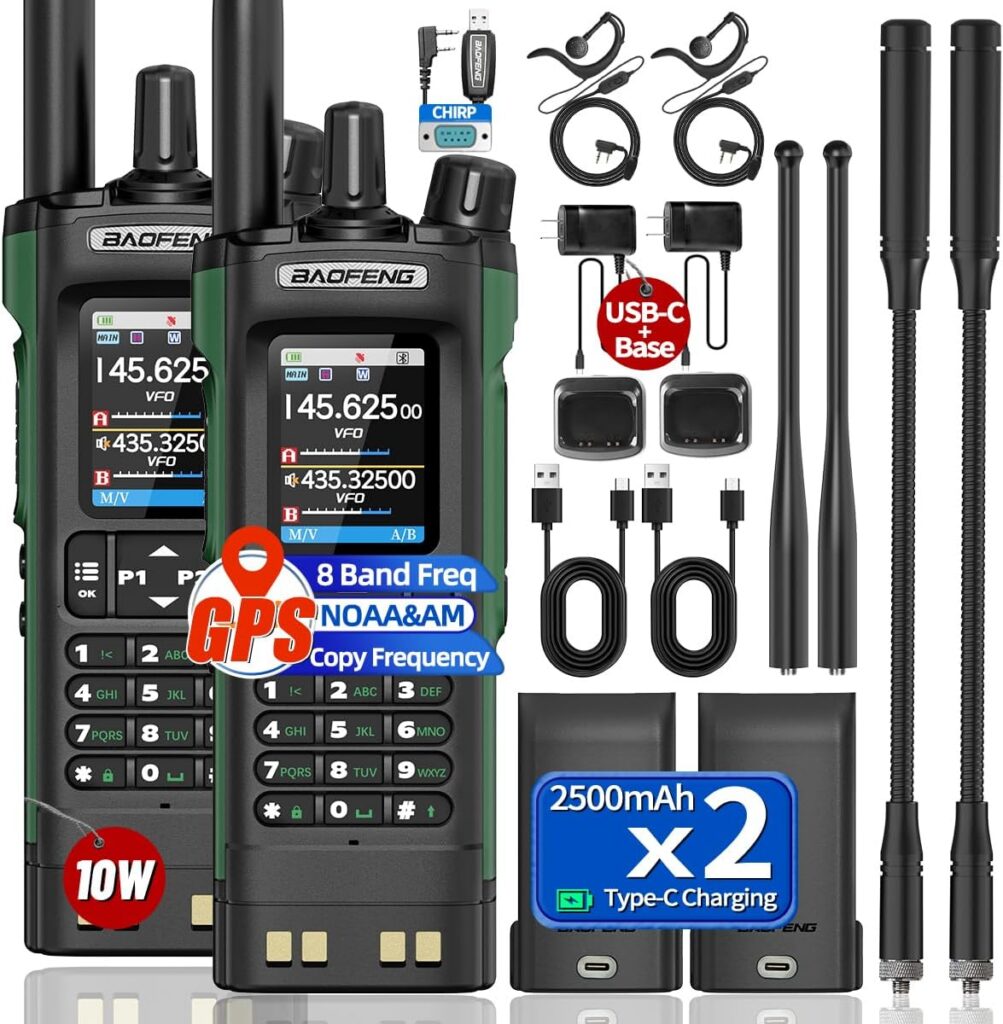
This is where the digital layer I described above comes into play. The DM-32 (often sold as the DM-32UV) is a 10-watt multi-band radio that runs both traditional analog FM and DMR — the same digital protocol a lot of commercial and public-safety outfits use.
Price: typically $85–$100, including antenna and battery — roughly 3–4x the cost of a UV-5R. In exchange you get a 2-inch color display, 4,000 programmable channels, GPS with digital APRS location tracking, NOAA weather alerts, and dual time-slot DMR capability.
Strengths: clearer digital audio in marginal-signal conditions, huge channel capacity for a serious multi-group COMMS plan, and GPS/APRS tracking that lets you see team positions on a shared network — valuable for a bug-out group moving through unfamiliar terrain.
Weaknesses: the programming software has a real learning curve (codeplugs, talkgroups, color codes — nothing like punching a frequency into a UV-5R), it’s heavier and pricier, and if your whole team isn’t running DMR-capable radios, you’ll mostly run it in analog mode anyway to stay compatible with everyone else.
How-To — DM-32 Basics: Power on with the top knob, same as the others. The screen will show you’re in either Analog or Digital (DMR) mode — toggle this before you transmit, because sending DMR to someone expecting analog FM gets you dead air on their end. For basic analog use, it behaves almost exactly like the UV-5R. For DMR, program a codeplug via the manufacturer’s software (not CHIRP) that defines your talkgroups, DMR ID, and color code. Get this radio programmed and locked in on your workbench before it’s a crisis tool — this is not a “figure it out in the field” radio.
The Baofeng AR-152
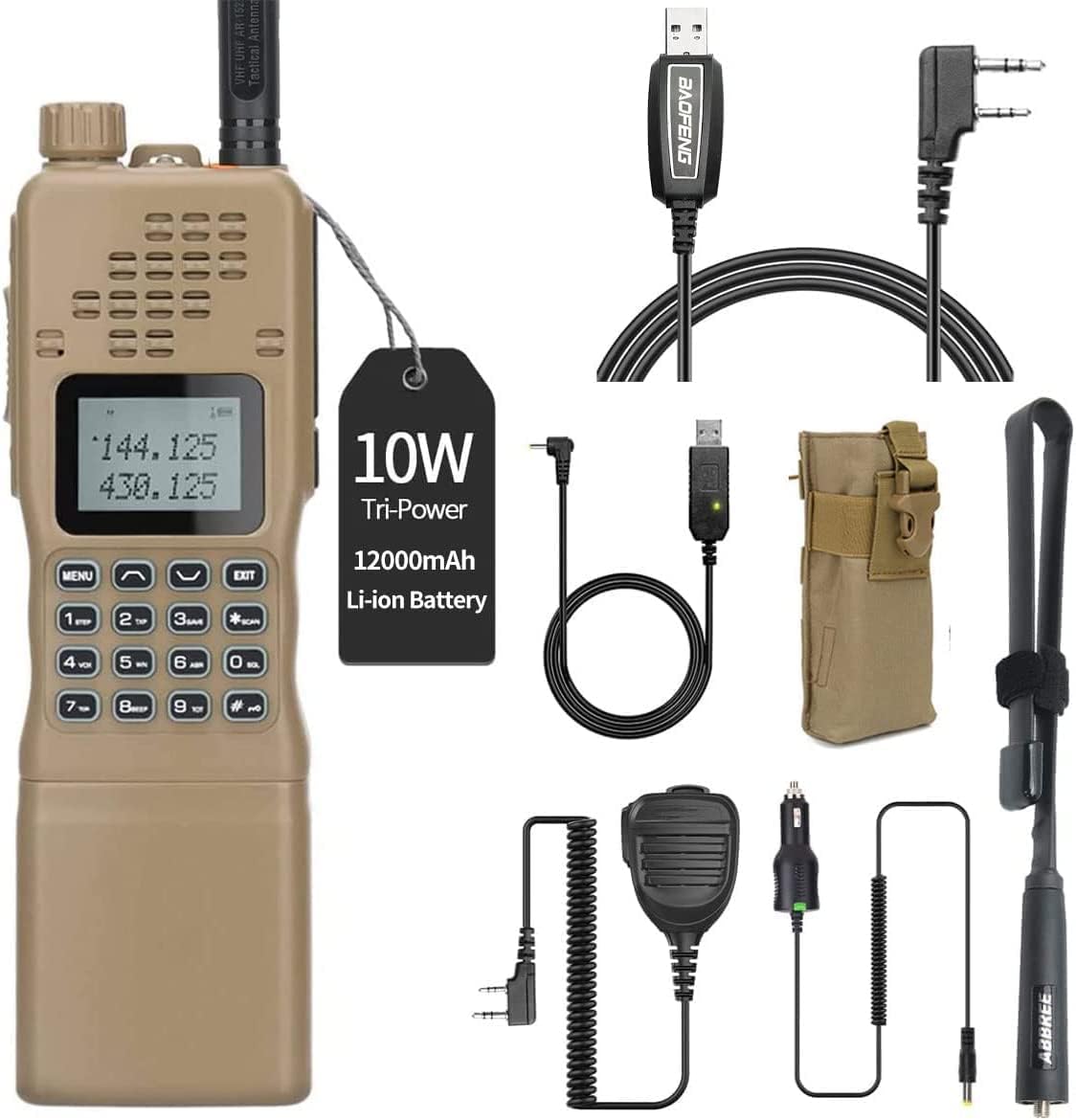
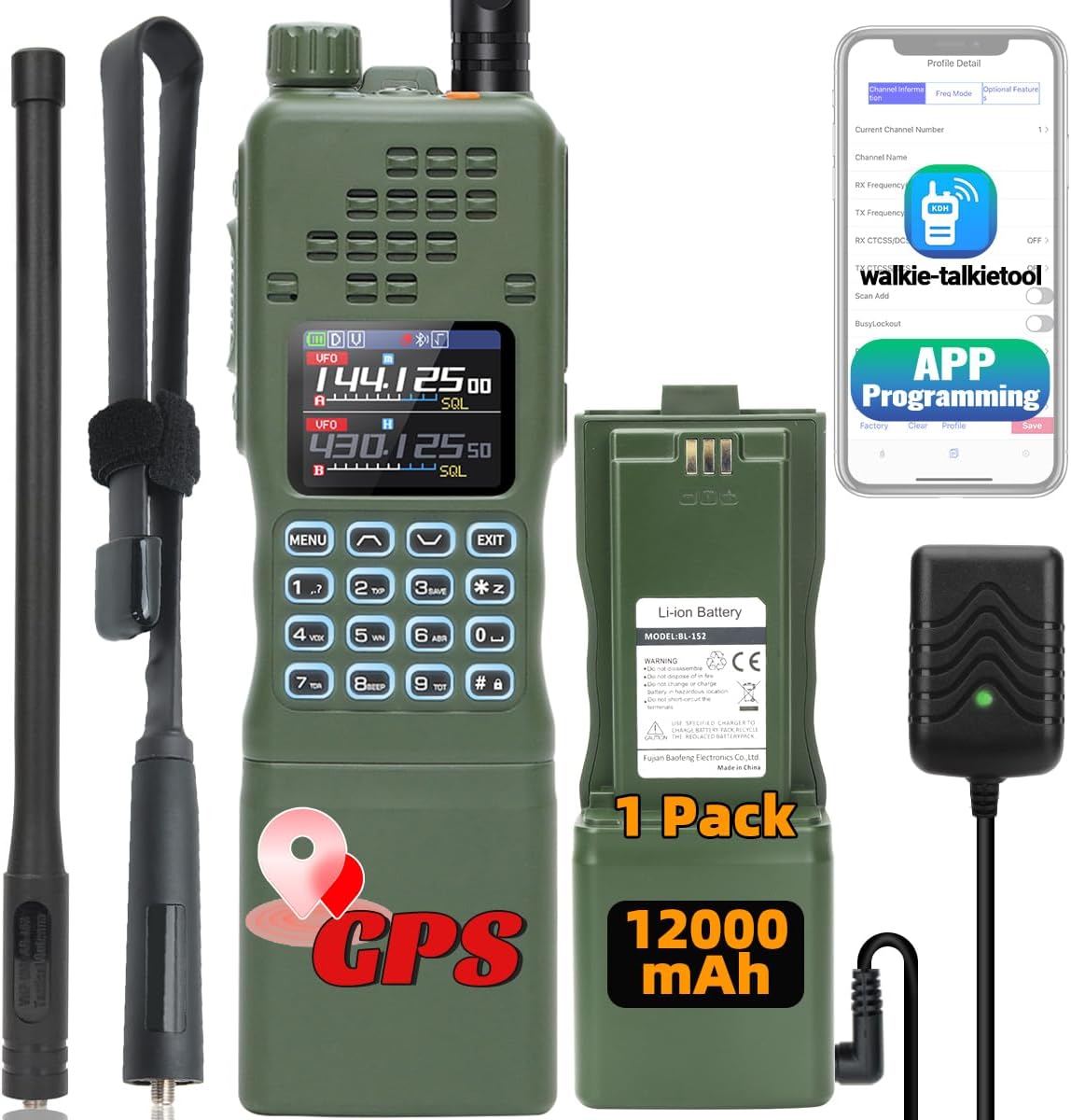
The AR-152 is Baofeng leaning hard into the tactical aesthetic — styled to resemble a military PRC-152, with a boxy tactical antenna, extended battery, and rugged olive-drab housing.
Price: typically $60–$90 depending on retailer and whether it’s the standard or “PRO” version (the PRO adds Bluetooth app programming, wider frequency scanning up to 520MHz, and GPS/BeiDou positioning). Functionally, under the hood, it’s closer to a beefed-up UV-5R than a true military radio — don’t let the look fool you into thinking it has capabilities it doesn’t.
Strengths: excellent battery life thanks to extended packs (3800–12000mAh depending on version), 10W output for more punch, water-resistant sealing that’s a real step up for field use, and DMR capability on some configurations. There’s also a real team-cohesion value in having matched-looking radios for low-vis operations.
Weaknesses: the small LED display is genuinely hard to read in bright sunlight or under night vision, it’s pricier than a base UV-5R for incremental gains, and Bluetooth programming reliability has been inconsistent across units in field reports.
How-To — AR-152 Basics: Power on and volume follow the same knob convention as the rest of the lineup. The big difference is initial setup — use the companion phone app over Bluetooth to program channels instead of a cable and CHIRP; faster once you’re used to it, but it means you need a charged phone during setup. PTT and basic transmit/receive mirror the UV-5R. There’s a dedicated shortcut button for NOAA weather alerts — press and hold to jump straight to weather channels. Because of the extended battery, budget extra charge time before you rely on it.
Price Breakdown at a Glance
| Radio | Typical Price | Band/Mode | Best For |
|---|---|---|---|
| UV-5 | $18–$25 | VHF/UHF Analog | Bulk buying, teaching beginners, backup units |
| UV-5R | $23–$30 | VHF/UHF Analog | Primary family/team radio, best all-around value |
| DM-32 | $85–$100 | VHF/UHF Analog + DMR | Multi-team COMMS plans, digital clarity, GPS tracking |
| AR-152 | $60–$90 | VHF/UHF Analog (+DMR on some) | Extended runtime, rugged field use, tactical-styled kit |
Building the Plan, Not Just the Kit
A radio sitting in a drawer isn’t a comms plan — it’s a paperweight with better range. Once you’ve got hardware, the real work is the plan behind it: a written frequency/channel list every household member carries (laminated, in the bag, not just memorized), a schedule for radio checks, an agreed-upon set of brevity codes or plain language protocol (I lean plain language — codes fail when stress is high and memory is short), and redundancy across bands so one point of failure doesn’t take down your whole network. Store radios with the battery removed or trickle-charged in a Faraday-protected container alongside spare batteries and a hand-crank or solar charging option, because a radio with a dead battery is no different than no radio at all.
If I’m building out a Collapse Ready household comms plan from scratch, here’s how I’d actually spend the money: UV-5Rs for every family member as the baseline — cheap enough that losing or breaking one isn’t a crisis, simple enough that your kids can run one. One or two DM-32s at the household “base station” level for whoever’s coordinating across a wider network. And an AR-152 or two for whoever’s running perimeter or long-duration overwatch, where battery life and ruggedness earn their keep. None of this replaces real training, and none of it replaces getting licensed and understanding the legal landscape you’re operating in. But dollar for dollar, this approach gives you more redundant, learnable, field-proven comms capability than almost anything else on the market — and when the rest of the grid goes quiet, that’s exactly the gap radio is built to fill.
When Systems Fail, We Don’t