Survival Poaching: Last-Resort Game Procurement When the System Has Already Failed
⚠️ LEGAL DISCLAIMER — READ BEFORE PROCEEDING
Hunting any animal out of legal season, without the required license/tags, or in violation of state and federal wildlife law is a crime in every U.S. jurisdiction, and in most cases a serious one — carrying fines, license revocation, seizure of firearms/equipment, and potential jail time under state game codes and, for certain species, federal statutes like the Lacey Act and Migratory Bird Treaty Act. Nothing in this article is an endorsement of illegal hunting, and Collapse Ready Household does not condone poaching under normal circumstances.
This article exists for one reason: to prepare households for a genuine, sustained collapse or survival emergency — a scenario where the rule of law, game wardens, licensing systems, and the food supply chain have broken down to the point where legal hunting seasons are no longer a meaningful or enforceable concept, and procuring food outside the normal legal framework becomes a matter of survival rather than sport or convenience. Treat everything below as knowledge to be held in reserve for that specific scenario, not a how-to guide for the here and now. If you are reading this under normal conditions, get your license, learn your local regulations, and hunt legally — it will make you better at all of this anyway.
With that fully understood, let’s talk about what it actually takes to procure game outside the legal framework when there is no other option left. This is the darkest and most operationally serious article in the Collapse Ready Household library, and I’m writing it the way I’d brief a team: no fluff, no romanticism about “living off the land,” just the hard technical detail on tracking, weapon and trap selection, shot placement, field dressing, and what not to eat no matter how hungry you get.
Understanding the Scenario Before the Technique
Survival poaching only makes sense as a concept in a context where normal food systems have failed for an extended period — grid-down, currency collapse, supply chain breakdown, or a regional disaster with no near-term resolution. In that context, game wardens and rangers may still be operating (they don’t disappear on day one), local hunting pressure will spike dramatically as other desperate people have the same idea you do, and game populations in accessible areas will be depleted fast. Plan around all three of those realities: you need to be quiet, you need to be efficient with every shot and every trap set, and you need to know your terrain better than the people who’ll be competing with you for the same deer.
Tracking and Locating Deer and Other Game
Deer — Whitetail and mule deer are creatures of habit, and that habit is your primary tool. Locate active bedding areas (thick cover near food and water, often on elevated terrain with good sightlines) and feeding areas (agricultural fields, mast-producing oak stands, browse lines in young forest) and identify the travel corridors connecting them — these are usually well-worn game trails, often following ridgelines, saddles between hills, or field edges. Fresh tracks (sharp edges, no debris settled in them), fresh droppings (moist, dark, not sun-bleached), and rub lines or scrapes (in fall, from bucks) all confirm active use. Deer move most at dawn and dusk (crepuscular activity), so your highest-probability windows are the first and last hour of daylight.
Wild hogs — Increasingly present across the Southeast, Texas, and expanding elsewhere, feral hogs are highly destructive, prolific breeders, and in most states classified as invasive/nuisance species with minimal or no season restrictions even under normal law — meaning in many states you may already be able to hunt them without the same legal exposure as deer. Look for rooting damage (torn-up earth in fields or under oak stands), wallows (mud pits near water sources), and well-defined trails through thick brush. Hogs have poor eyesight but excellent smell and hearing, so wind direction matters as much as with deer.
Small game (rabbits, squirrels) — Far more abundant and far less risky to pursue than deer in terms of both effort and the legal/practical stakes if you’re caught. Squirrels concentrate around mast trees (oak, hickory, walnut); rabbits favor brushy field edges, hedgerows, and bramble patches. Both are most active early morning and late afternoon.
Turkey — Roost in trees at night, typically over water or in mature timber, and fly down at first light to feed in open areas. Locating a roost the evening before via listening for wing-beats at dusk, then setting up nearby before dawn, is the standard approach.
General tracking discipline — Move slowly, stop frequently, and use binoculars to glass terrain from a stationary position rather than walking through it — you’ll see far more game than you spook. Pay attention to wind direction constantly; deer and hogs will smell you from hundreds of yards if the wind is wrong, no matter how quiet you are.
Weapon and Trap Selection Overview
Your weapon choice should be driven by three factors in a survival context: ammunition availability (what you can actually source or already have stockpiled), noise signature (a rifle shot carries a mile or more and announces your position to everyone else in the area, including people who may want to take your kill or your gear), and the size of game you’re realistically pursuing. Traps and snares deserve serious consideration in this context because they work 24 hours a day without you present, make no noise at the moment of the kill, and let you cover far more ground than a single hunter with a rifle ever could.
Firearms give you the most reliable, humane kill at range but come with a hard noise signature and a finite ammunition supply that will not be resupplied in a real collapse.
Bows and crossbows are nearly silent, reusable (arrows/bolts can often be recovered and reused), and require no ammunition resupply chain — the tradeoff is a much shorter effective range and a real skill requirement to place a killing shot.
Traps and snares (where legal — and even in a survival context, wire snares and deadfalls are a serious skill investment) are silent, passive, and let you run multiple sets across your area simultaneously, but they take real skill to place effectively and are best suited to small game rather than deer-sized animals for an average person’s skill level.
For a household building a genuine last-resort capability, I recommend having at least one option from each category: a quiet rimfire for small game, a mid-range centerfire rifle or shotgun for deer/hog-sized game, and a bow or crossbow for the silent option when noise discipline matters most.
Rifle Options: Low to Mid-Cost Breakdown
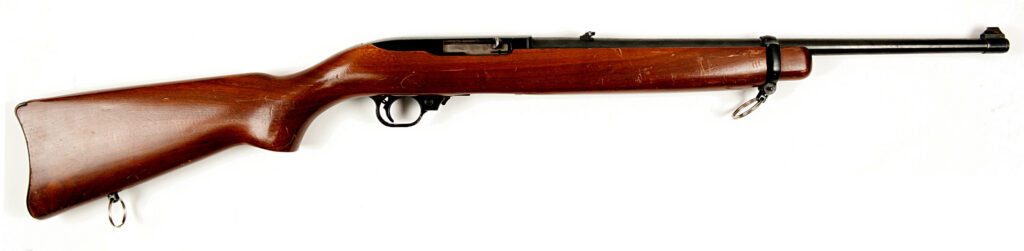
Ruger 10/22 semi-automatic .22 LR rifle
Ruger 10/22 (.22 LR) — $259-329 new. The best-known small-game and pest rifle in America for good reason: dead quiet compared to centerfire rifles, ammunition is cheap and was historically the most stockpiled civilian caliber in the country, and it’s effective on squirrel, rabbit, and small predators out to 50-75 yards. Not adequate for deer-sized game in most states’ legal minimum-caliber requirements and shouldn’t be relied on for deer/hog even in a survival context — it lacks reliable stopping power at that size.
Marlin/Ruger American in .22 WMR or .17 HMR — $280-400 new. A step up in range and knockdown power from standard .22 LR while remaining quiet and cheap to shoot, good for larger small game and predators.
Bolt-action .243 Win or .270 Win (e.g., Ruger American, Savage Axis) — $400-550 new. This is the entry point for genuine deer-capable rifles. Moderate recoil, widely available ammunition (in normal times), effective to 200+ yards in capable hands. The Savage Axis and Ruger American lines are specifically built as budget-friendly, accurate hunting rifles.
Bolt-action .308 Winchester (e.g., Remington 700, Savage 110) — $500-750 new. The .308 is arguably the single best all-around survival caliber for deer, hog, and larger game: widely available ammunition historically, effective well past 300 yards, and the platform (bolt-action) is simple, reliable, and easy to maintain without specialized tools.
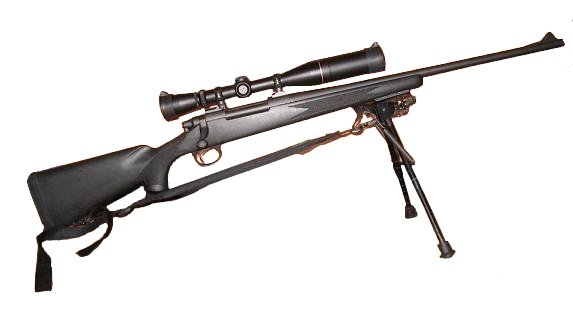
Remington 700 bolt-action rifle, chambered options include .308 Winchester
AR-15 platform (5.56/.223) — $500-900 for a basic but reliable build. The most common modern sporting rifle in America, meaning magazines, parts, and ammunition were the most widely stockpiled civilian rifle system prior to any collapse scenario. Adequate for hog and coyote-sized game at moderate range; opinions are split on adequacy for deer (legal in some states, restricted in others due to bullet performance debates), but in a survival context it’s a highly practical platform due to sheer ammunition commonality and semi-automatic follow-up shot capability.
Whichever caliber you choose, prioritize a caliber for which ammunition was common and cheap before any disruption — .22 LR, 5.56/.223, .308 Win, and 12-gauge shotgun shells were, by a wide margin, the most stockpiled civilian ammunition types in America, meaning they’re the most likely to be tradeable, findable, or already in your own cache when it matters.
Shotgun Options: Low to Mid-Cost Breakdown
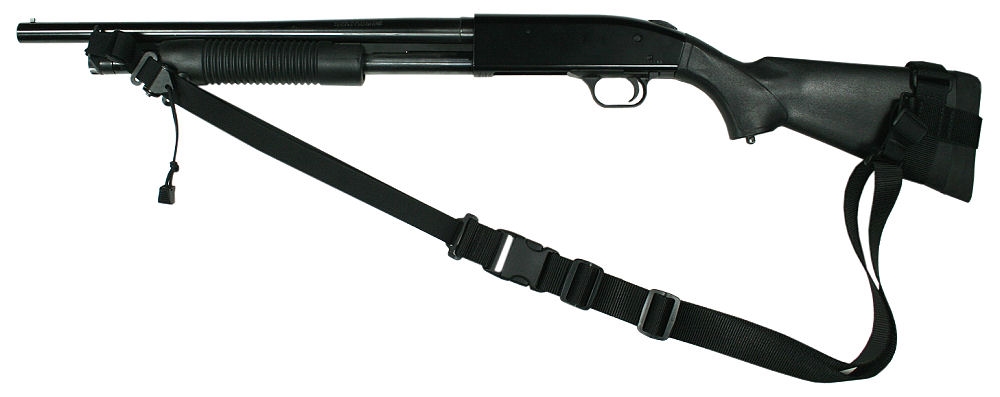
Mossberg 500 pump-action shotgun
Mossberg 500 / Maverick 88 (12 or 20 gauge) — $250-400 new. The most common, most reliable, and most affordable pump shotgun platform in America, and genuinely the most versatile firearm on this list — switch between birdshot for small game and turkey, buckshot for hog/deer at close range, or rifled slugs for deer at moderate range, all from the same gun.
Remington 870 — $350-500 new. The other iconic pump shotgun platform, equally reliable, with the same versatility across shot sizes and slugs.
A pump shotgun is arguably the single most practical “one gun” answer for survival poaching across multiple species because of that shot-size flexibility — a single Mossberg 500 with a mixed supply of birdshot, buckshot, and slugs covers everything from squirrel to deer.
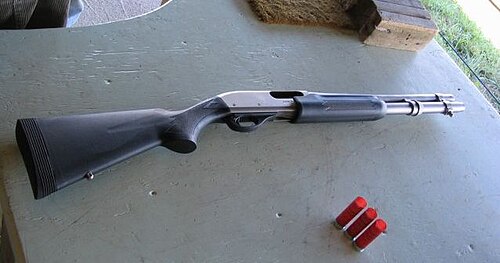
Remmington 870
Bow and Crossbow Options: Low to Mid-Cost Breakdown
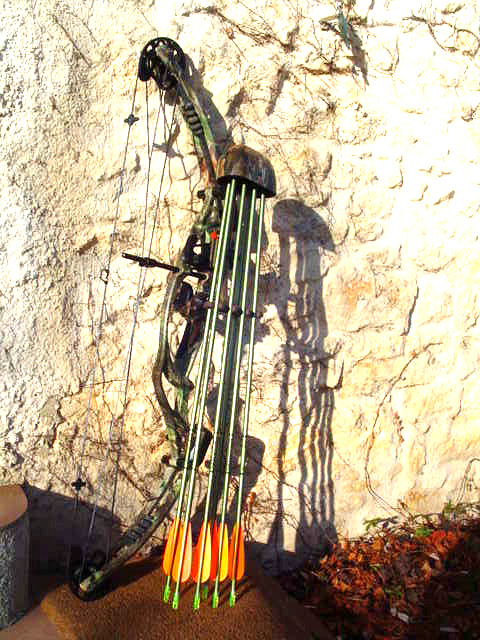
Compound bow set up for hunting
Entry-level compound bow (e.g., Bear Archery, Diamond Archery packages) — $250-450 new, often bundled with sight, rest, and stabilizer. Silent, effective on deer and hog out to 20-40 yards for a practiced shooter, arrows are recoverable and reusable indefinitely with basic fletching maintenance — a major advantage when resupply isn’t an option.
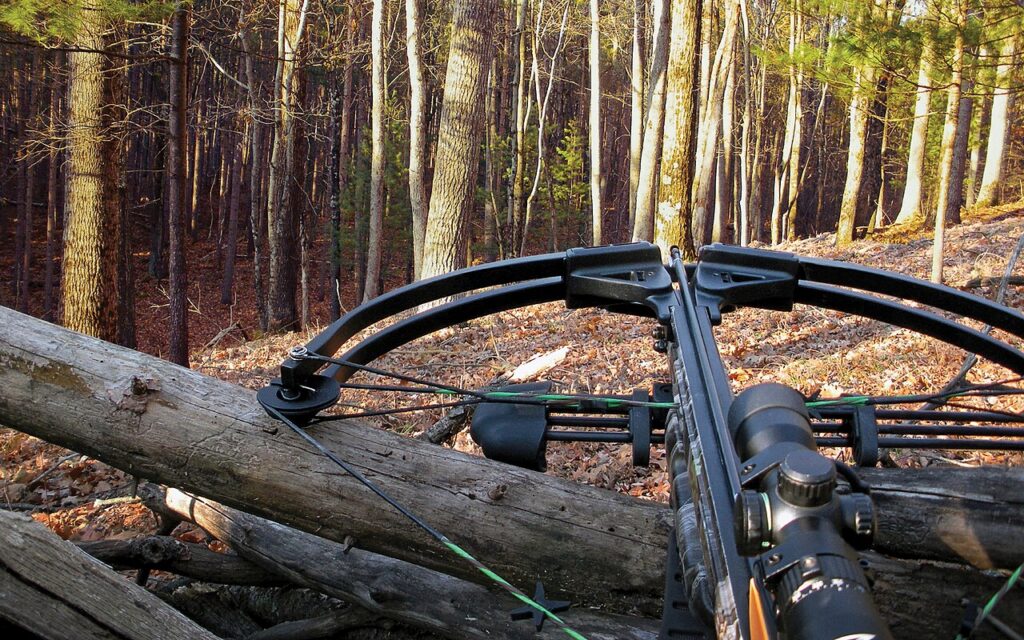
Crossbow set up for hunting whitetail deer
Entry-level crossbow (e.g., Barnett, CenterPoint packages) — $300-500 new, often bundled with scope and bolts. A crossbow has a much shorter learning curve than a compound bow — it holds at full draw and aims like a rifle, making it a better choice for someone without months to invest in archery practice before they need results. Effective range is similar to a compound bow, roughly 20-40 yards for an ethical, confident shot.
Both platforms share the same core advantage in a survival context: total silence at the moment of the shot, no muzzle flash or report to give away your position, and reusable ammunition. The tradeoff is a hard requirement for practice — an unpracticed shooter with a bow or crossbow will wound and lose more animals than they harvest cleanly, which is both a waste of a precious resource and inhumane. If you’re building this capability, put in range time now, while it’s still just a hobby.
How-To: Shot Placement on Game Animals
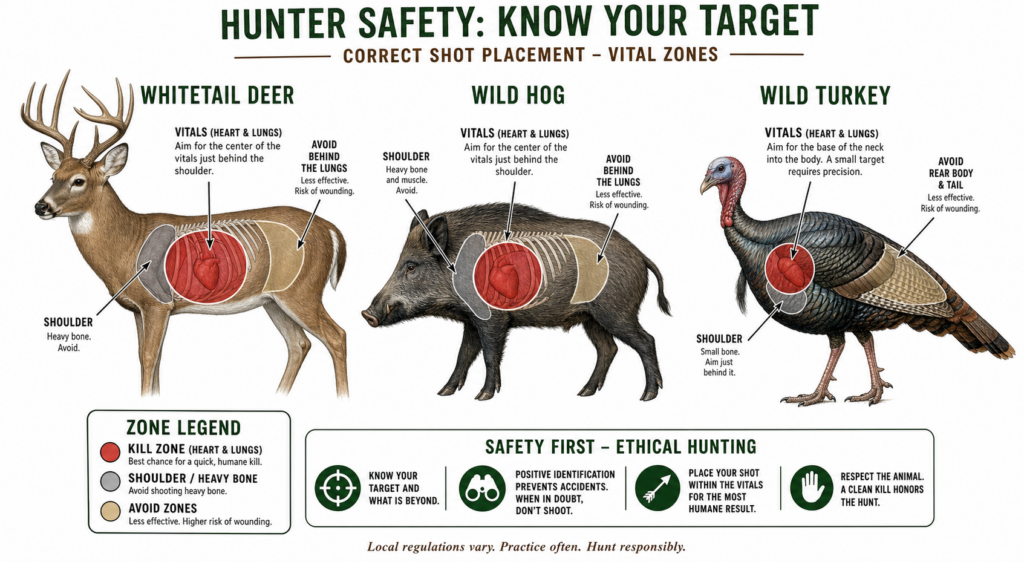
Shot placement diagram showing vital kill zones on deer, hog, and turkey
Ethical, effective harvesting comes down to hitting the vital organs — heart and lungs — in a single shot whenever possible, both to minimize animal suffering and to avoid a lost, wounded animal that ran off before expiring (wasted meat, and a noise/blood trail that can attract predators or reveal your position).
Deer, broadside stance — Aim roughly one-third up the body from the bottom of the chest, directly behind the front shoulder. This places the shot through both lungs and often the heart. Avoid a straight-on frontal shot unless you’re experienced — the vital zone is much smaller from that angle and shoulder/leg bone deflection is a real risk.
Deer, quartering-away stance — Aim to enter behind the last rib on the visible side, angling the shot forward toward the offside shoulder, which drives through both lungs.
Wild hog — Hogs carry a heavy shield of cartilage and fat over the front shoulders (“shield” in mature boars) that can stop or deflect a marginal shot. Aim slightly further back than you would on a deer — mid-body, one-third up from the bottom, just behind the front leg — to get under the shield and into the lung/heart area. A quartering-away shot avoiding the shield entirely is often more reliable on a mature hog than a straight broadside shot.
Turkey — The vital target is much smaller than deer or hog. With a shotgun, aim for the head/neck at close range using appropriate turkey loads. With a bow or crossbow, the vital zone is the body cavity — aim just above the leg, at the base of the wing butt, for a shot through the vitals; a head/neck shot with archery equipment is far less reliable and not recommended.
Small game (rabbit, squirrel) — With a .22 rifle, a head shot preserves the maximum amount of meat and is the standard practice for experienced small game hunters; a body shot works but destroys more usable meat. With a shotgun, aim center-mass — the shot pattern does the rest of the work.
General principles — Never take a shot you’re not confident will land in the vital zone. A marginal hit creates a wounded, suffering animal that may travel for miles before expiring, wasting the resource entirely and creating unnecessary noise and blood scent in your area. Know your weapon’s and your own effective range, and don’t extend beyond it under pressure.
How-To: Field Dressing and Cleaning Game
Deer and hog (large game): 1. Work quickly — bacteria growth accelerates fast in warm weather, and gut bacteria can taint meat within hours if not addressed. 2. With the animal on its back, make a shallow incision from the base of the sternum to the pelvis, being careful not to puncture the stomach or intestines (cut through skin/muscle only, using two fingers to guide the knife tip and lift away from the gut cavity). 3. Cut around and remove the anus/reproductive organs from the pelvic opening, then reach in and sever the diaphragm and windpipe/esophagus at the front of the cavity. 4. Roll the entire gut mass out of the cavity, working carefully around the bladder to avoid rupturing it. 5. Prop the cavity open (a stick works fine) to allow it to cool and drain, and if possible, hang the animal by the hind legs to fully drain blood and speed cooling. 6. Skin as soon as practical, then quarter and debone in a clean, cool environment, keeping the meat away from dirt, hair, and gut contents at every step. 7. Cool the meat as fast as possible — ice, a cold stream, or simply hanging in shade with good airflow overnight in cold weather — before any further processing or storage.
Small game (rabbit, squirrel): Field dressing is far simpler — a small incision through the belly skin, remove the entrails, skin (rabbits skin very easily by hand once you learn the technique; squirrels typically require a small cut-and-peel method starting at the base of the tail), and the whole animal is ready to cook or store within minutes.
Turkey: Pluck or skin (skinning is faster and easier in the field, at the cost of the skin/fat layer), remove entrails through a cavity incision similar to small game, and process the breast, thighs, and legs as usable meat.
Animals to Avoid — No Matter How Hungry You Get
Not everything that moves is safe to eat, and desperation has killed more people than starvation alone ever would. Avoid these categories entirely:
- Any animal found already dead (roadkill in an unknown state, or found deceased with no clear cause) — you don’t know the cause of death, how long it’s been dead, or what pathogen load it’s carrying. The risk of severe foodborne illness or worse far outweighs the calories.
- Predators and scavengers (raccoons, opossums, skunks, vultures/buzzards, and other carrion-eaters) — these animals accumulate disease and parasite loads from their diet and carry meaningfully higher rabies risk. Raccoons in particular are a significant rabies vector in North America.
- Visibly sick or abnormally behaving animals — an animal that’s stumbling, unafraid of humans in a way that’s not normal for the species, drooling excessively, or otherwise acting “off” may be rabid or carrying another serious pathogen. Do not approach, and absolutely do not consume.
- Bats, of any species, under any circumstances — extremely high rabies vector risk relative to any nutritional value they offer; not worth the risk under any survival scenario.
- Amphibians and reptiles you can’t positively identify — some toads and salamanders carry toxic skin secretions, and several snake species are venomous. If you can’t make a 100% positive ID, don’t handle or consume it.
- Any animal exhibiting visible tumors, abscesses, unusual discoloration of organs/fat, or a foul smell upon field dressing — discard the entire animal. This is your body telling you something is wrong before you eat it, and it’s far cheaper to lose one animal than to spend a week incapacitated by food poisoning or parasitic infection when medical care may not be available.
- Insects and grubs you cannot positively identify as edible — while many insects are legitimately excellent survival protein, some are toxic or carry parasites; know your species before eating anything with more than four legs.
When in doubt, don’t eat it. A day without food is a manageable problem. A severe parasitic infection, rabies exposure, or food poisoning with no available medical care is a potentially fatal one.
Final Word
Survival poaching is knowledge you hope to never need and hold in reserve for the day the legal and logistical systems around food procurement have genuinely broken down. Build the skill now — legally, with a license, during an actual season, on land you have permission to hunt — because the tracking, marksmanship, and field dressing skills are identical whether you’re doing it lawfully on opening day or out of necessity in a true collapse. The only thing that changes is the paperwork, and the paperwork matters until the day it genuinely doesn’t.
When Systems Fail — We Don’t.