Meat Rabbits: The Quiet, Efficient Protein System Every Prepper Overlooks
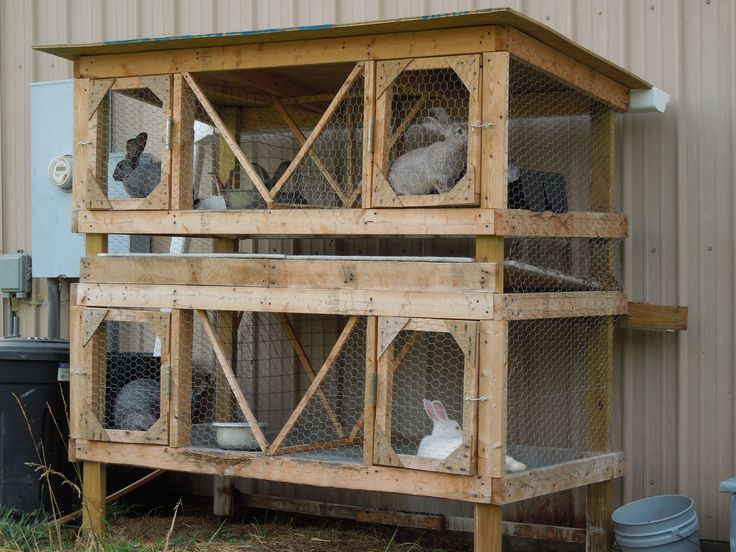
Every homestead conversation I have eventually turns to chickens, and almost never to rabbits — which is a mistake, because rabbits out-produce nearly every other backyard livestock option on a pound-of-meat-per-square-foot basis. A single doe can produce 25-40 lbs. of dressed meat per year from a hutch that fits in a corner of a garage or shed, on a fraction of the feed a chicken flock needs, with zero noise, zero odor complaints if managed properly, and zero zoning red flags in most municipalities because rabbits are legally classified as “pets” almost everywhere chickens are restricted. This article breaks down everything you need: why rabbits belong in your food security plan, the best breeds for meat production, care fundamentals, a complete How-To for building a hutch, cost breakdowns, sourcing, and feed — including DIY options for when commercial feed isn’t available.
Why Meat Rabbits Belong in a Collapse-Ready Food Plan
Rabbits are, pound for pound, one of the most efficient meat animals available to a small household. A doe reaches breeding maturity at 5-6 months, produces litters of 6-10 kits after a gestation of just 31 days, and those kits reach fryer weight (4-5 lbs. live weight) in 8-12 weeks. Do the math on that reproduction rate and you’ll see why rabbits were the historic go-to meat animal for besieged cities, wartime rationing programs, and Depression-era households — a single breeding trio (one buck, two does) can realistically produce 100-200+ lbs. of dressed meat annually in a space smaller than a garden shed.
Rabbits also solve the noise and zoning problems that make chickens or larger livestock impractical in many suburban and urban settings. A rabbit hutch produces essentially no noise, no rooster crowing, no complaints from neighbors, and in most municipalities, rabbits fall under the same ordinance category as pet rabbits — meaning no special livestock permit is required where chickens might be restricted or banned outright. That makes rabbits one of the few meaningful protein-production systems available to preppers in dense suburbs or even some urban lots.
Feed efficiency is another major advantage. Rabbits convert feed to meat at roughly a 4:1 to 6:1 ratio (feed pounds to meat pounds), competitive with or better than most poultry, and they can subsist heavily on forage, garden waste, and hay — inputs a household can grow itself, unlike grain-based feeds that depend on a functioning supply chain. In a genuine collapse scenario, a rabbitry backed by a home garden and hay supply is one of the few livestock operations that can run largely self-sufficient.
Finally, rabbit meat itself is nutritionally excellent — high protein, low fat, mild flavor that takes well to nearly any recipe you’d use for chicken, and it was a dietary staple across multiple continents for centuries before falling out of mainstream American habit. Reintroducing it to your household now, while you have the luxury of a functioning grocery store as backup, means your family already has the palate and the cooking knowledge built in before you ever need it to matter.
Best Rabbit Breeds for Meat Production
New Zealand White — The gold-standard commercial meat rabbit and the breed most 4-H and commercial operations default to. New Zealand’s grow fast, reach 9-12 lbs. at maturity, produce large litters, and have calm, easy-to-handle temperaments. Widely available and the safest first choice for a new rabbit raiser.
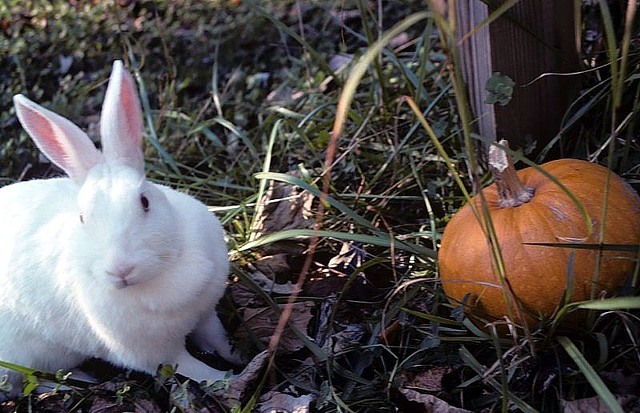
New Zealand White rabbit, the top commercial meat breed
Californian — Developed specifically by crossing New Zealand Whites with Chinchilla and Himalayan rabbits for meat production, Californians have an excellent meat-to-bone ratio, reach fryer weight (4-5 lbs) in 8-12 weeks, and are prized for a higher dressed-meat percentage than many other breeds. Recognizable by their white coat with black “points” on the ears, nose, feet, and tail.
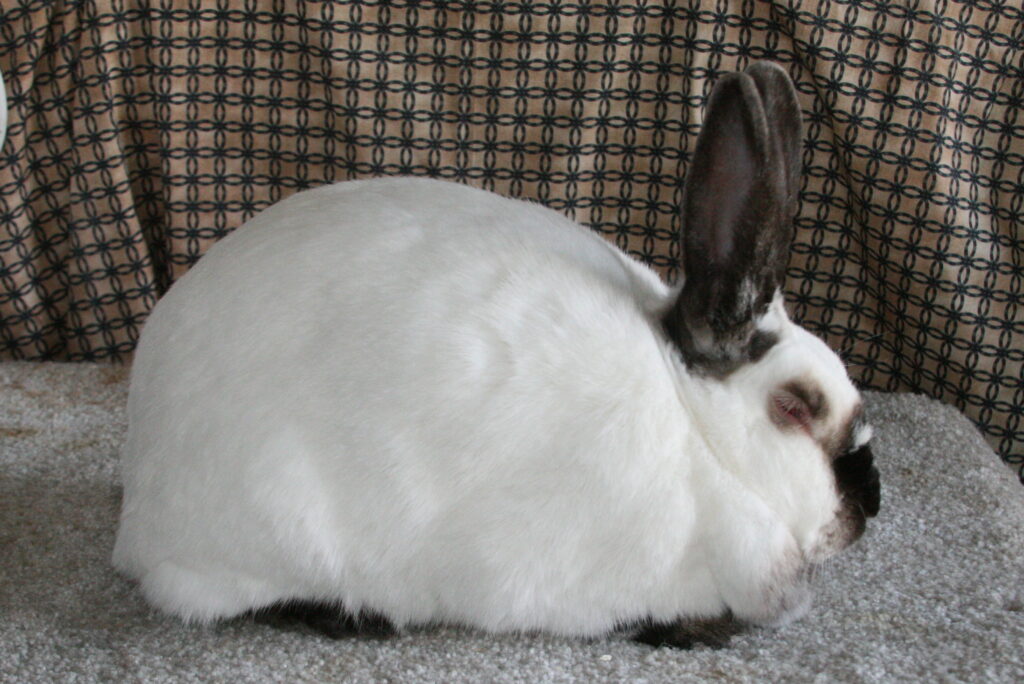
Californian rabbit, a top meat breed
Silver Fox — A heritage American breed on the Livestock Conservation List, Silver Fox rabbits grow a bit slower than commercial hybrids but produce excellent meat, tolerate cold well, and have a famously docile temperament that makes them ideal for families raising rabbits with children involved in daily care.
Rex — A dual-purpose breed valued for both meat and its notably plush, velvet-like pelt, which has real trade/barter value in a collapse scenario. Rex rabbits reach 7.5-10.5 lbs. at maturity and are a good choice if you want a byproduct beyond meat.
Flemish Giant (or Flemish Giant crosses) — The largest domestic rabbit breed, with mature weights of 13-22 lbs. Flemish Giants grow slower and eat more than commercial meat breeds, but a Flemish Giant cross (commonly crossed with New Zealand or Californian) combines size with better growth efficiency, giving you a bigger carcass per animal if space for cages is your limiting factor rather than feed cost.
For a standard household operation, I recommend New Zealand White or Californian as your foundation breeding stock — both are widely available, well-documented, fast-growing, and forgiving of beginner mistakes.
Core Rabbit Care Practices
Housing needs to keep rabbits dry, shaded, ventilated, and protected from both extreme heat (rabbits are far more vulnerable to heat stroke than cold) and predators. A wire-floor hutch that allows droppings to fall through keeps rabbits cleaner and reduces parasite load dramatically compared to solid-floor housing.
Feed for a breeding rabbit operation is typically a commercial 16-18% protein rabbit pellet, supplemented with hay (critical for digestive health — rabbits need constant access to fiber), and fresh greens or garden scraps in moderation.
Water must be available at all times via a gravity-fed bottle or automatic watering system; rabbits, especially nursing does, drink substantially more water than people expect and dehydration will crash milk production and kit survival fast.
Breeding management requires keeping bucks and does separated except for planned breeding, tracking gestation (31 days) so you can provide a nest box 3-4 days before kindling, and giving does a recovery period between litters (most commercial operations rebreed 4-6 weeks post-kindling, though a more conservative 8–10-week cycle reduces doe burnout for a hobby-scale operation).
Temperature management is critical in summer — rabbits can die from heat stress above roughly 85°F, especially heavier breeds. Frozen water bottles placed in the hutch, shade, and good airflow are non-negotiable in hot climates. In winter, rabbits handle cold far better than heat, but wind protection and dry bedding matter.
Health monitoring should include checking for overgrown teeth or nails, ear mites, soft or runny stool (a sign of digestive upset, often from too many fresh greens too fast), and respiratory issues (snuffles), which spread quickly in close quarters and often require culling affected animals to protect the rest of the herd.
Sanitation — clean droppings trays or ground beneath wire-floor hutches regularly. Rabbit manure is actually one of the best garden fertilizers available and, unlike most manures, can be applied directly to garden beds without composting first (“cold” manure), closing another nutrient loop for a self-sufficient household.
How-To: Building a Rabbit Hutch
This design is a raised, two-section hutch suitable for a breeding doe (or a grow-out batch of 4-6 fryers), built from standard lumber and welded wire.
Step 1 — Frame the base. Build a rectangular frame 30 inches deep by 36 inches wide using 2×4 lumber, then attach four 24–30-inch legs (2×4 or 4×4) to elevate the hutch off the ground — this keeps rabbits dry, improves airflow, and makes daily care easier on your back.
Step 2 — Wire floor. Attach 1/2 inch x 1 inch welded wire mesh (14-gauge, “hutch cage wire”) across the floor of the frame, stapled securely to all edges. This allows droppings and urine to fall through, keeping the rabbit’s living space clean and dry, which is critical for preventing sore hocks and respiratory illness.
Step 3 — Frame and wire the walls. Frame the walls with 1×2 or 2×2 lumber and cover three sides and the top in 1×2 inch welded wire mesh (16-gauge is fine for walls/roof since it’s not bearing weight or abrasion like the floor). Leave the front as the access side.
Step 4 — Solid-wall nest box section. Partition roughly one-third of the hutch into an enclosed nest box area using solid plywood on all sides (including part of the floor, since kits need solid footing, not wire, to avoid leg injuries). This section should have a small entry hole (8×8 inches) connecting to the main wire-floor section and a hinged lid on top for access.
Step 5 — Roof. Build a sloped roof from plywood, extending 4-6 inches beyond the hutch on all sides, covered with roofing felt or a metal panel to shed rain and provide shade.
Step 6 — Access door. Frame a hinged wire door on the open (wire-floor) section large enough to reach in for daily care and cage cleaning, secured with a spring-loaded latch (rabbits and raccoons can both figure out simple hook latches).
Step 7 — Feeder and waterer mounts. Install a J-feeder (hangs on the wire, feed drops as consumed) and a gravity-fed water bottle or nipple-style watering system mounted externally so they can be refilled without opening the cage.
Step 8 — Multiple units. If raising a breeding trio, build 2-3 hutch units side by side (one per buck/doe, kept separate except during breeding), sharing a common roof structure to save materials and labor.
Rabbit Hutch Materials List
- (4) 2x4x8 lumber (legs and base frame)
- (2) 1x2x8 or 2x2x8 lumber (wall/roof framing)
- (1) roll 14-gauge, 1/2” x 1” welded wire mesh (for floor)
- (1) roll 16-gauge, 1” x 2” welded wire mesh (for walls/roof)
- (1) sheet 1/2” plywood (nest box walls/floor)
- (1) sheet plywood or metal roofing panel (roof)
- Fencing staples/hog rings for attaching wire
- Hinges and spring latches for access doors
- J-feeder and gravity water bottle or nipple waterer
- Wood screws, exterior wood glue/sealant
Rabbit Hutch Basic Price Breakdown
| Item | Estimated Cost |
| Framing lumber (2x4s, 1x2s/2x2s) | $60 – $90 |
| Welded wire mesh (floor + walls, ~2 rolls) | $80 – $130 |
| Plywood (nest box + roof) | $50 – $80 |
| Roofing material | $25 – $40 |
| Hardware (hinges, latches, staples) | $20 – $35 |
| Feeder + waterer | $20 – $35 |
| Total (single-unit DIY build) | $255 – $410 |
| Pre-built comparable hutch (retail) | $150 – $400 (single unit) |
Building your own typically costs about the same or slightly more than a basic pre-built hutch, but gives you a sturdier, better-ventilated structure with a properly sized nest box section — pre-built hutches at the low end of that price range are often flimsy and undersized for serious breeding use.
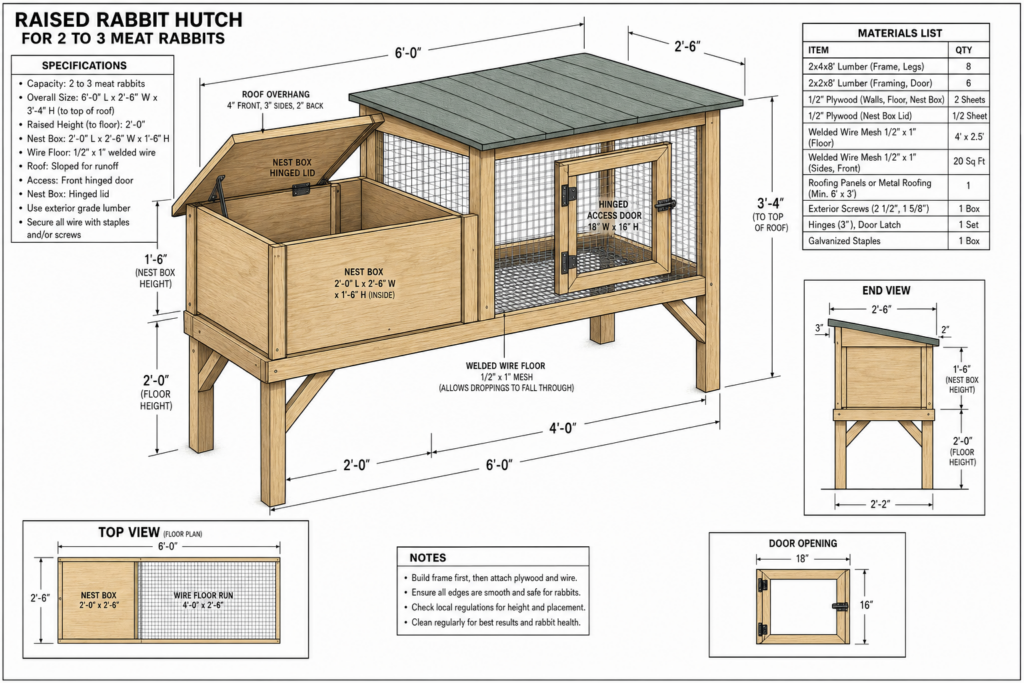
Rabbit hutch construction blueprint for 2-3 meat rabbits
Where to Buy Rabbits and Hutch Supplies
Live rabbits: Tractor Supply does not typically stock live rabbits, but local feed stores, county 4-H programs, and rabbit breeders listed through the American Rabbit Breeders Association (ARBA) breeder directory are your best sources for quality New Zealand or Californian breeding stock, generally $20-40 per rabbit for young stock and $40-75 for proven breeding adults. Local livestock swap meets, farm auctions, and Facebook homesteading/rabbit groups are also reliable sources, often cheaper than breeders selling show-quality stock.
Hutch-building supplies: Tractor Supply and Rural King both carry welded wire mesh, hutch hardware, J-feeders, and rabbit waterers as standard farm-supply stock. Lowe’s and Home Depot are fine for the lumber and plywood but generally don’t carry hutch-specific wire gauges — go to a farm store for that. Amazon carries complete hutch kits, wire mesh rolls, nest boxes, and nipple watering systems, often at competitive prices with the convenience of doorstep delivery.
Pre-built hutches: Tractor Supply, Rural King, and Amazon all sell pre-fabricated hutches in the single and double-unit range, generally $150-500 depending on size and quality.
Feed Costs and Sourcing
A breeding doe eats roughly 6-8 oz of pellet feed daily, more when nursing a litter (up to 12-16 oz/day). A 50 lb. bag of rabbit pellets runs $15-22. For a single breeding doe plus grow-out litters, budget roughly $12-20/month in pellet feed, supplemented heavily with hay (a 50 lb. hay bale runs $8-15 and will stretch for weeks) and garden scraps.
Where to source feed: Tractor Supply, Rural King, and local farm/feed stores are the standard sources for rabbit pellets and hay. Buying hay locally from a farmer rather than a feed store is often significantly cheaper if you have that option in your area — check local classifieds or farm co-op boards.
DIY and Emergency Rabbit Feed
Rabbits are herbivore foragers and adapt well to homegrown and foraged diets when commercial pellets aren’t available:
- Hay — always the foundation of a rabbit’s diet; grass hay (timothy, orchard grass) or alfalfa hay for nursing does needing extra protein and calcium
- Garden greens — carrot tops, kale, lettuce (in moderation), broccoli leaves, and most non-toxic garden trimmings
- Foraged greens — dandelion, clover, plantain weed, and grass clippings (pesticide-free only) are excellent free rabbit forage that most yards already produce
- Root vegetables — carrots, small amounts of sweet potato as an occasional treat and calorie boost
- Grain supplement — oats or a small amount of cracked corn for extra calories during nursing or cold weather
- Avoid — iceberg lettuce (low nutrition, can cause digestive upset), avocado, chocolate, and anything moldy
A household with even a modest garden and access to roadside or yard forage can feed a small rabbitry almost entirely without purchased pellets during the growing season, making rabbits one of the most self-sufficient meat animals available if commercial feed becomes unavailable or unaffordable.
Bottom Line
A single-unit rabbit hutch costs roughly $250-400 to build, breeding stock runs $20-75 per animal, and monthly feed costs for a doe and her litters run $15-30 — in exchange for potentially 100+ lbs. of dressed meat annually from a trio of rabbits housed in a space the size of a closet, with none of the noise or zoning headaches of larger livestock. If chickens are your Collapse Ready Household’s egg system, rabbits should be your meat system.
When Systems Fail — We Don’t.