The Collapse Ready EDC: Tools, Weapons, and Why You Need Them
By the Collapse Ready Household Series Editorial Team
A note to the reader: This article is written for the household prepper who already understands the why of EDC — you carry because the world is unpredictable, not because you’re paranoid. What follows is a deep-dive into what to carry, which version serves you best, and why the details matter more than the brand name. Every item covered here earns its pocket space through function, not fashion.
The Philosophy Behind a Collapse-Ready EDC
Most discussions about EDC focus on the gear list. This one focuses on the decision architecture behind it. A true collapse-ready EDC isn’t a dump of expensive gadgets — it’s a tightly curated toolkit where every item solves multiple problems, survives hard use, and doesn’t betray you at the worst possible moment. The items that follow were selected because they occupy the highest value-per-ounce real estate in a daily carry loadout. They bridge the gap between normal life and serious grid-down scenarios, and they do so without printing through a shirt, alerting TSA, or requiring a wheelbarrow.
Rule one of collapse-ready EDC: if you won’t carry it every day, it won’t be on your person when you need it. Comfort, concealability, and context all matter. The \$800 titanium superknife that stays in your gun safe because it’s “too nice” is worth exactly nothing when the situation calls for it.
Item 1: The Pocket Knife — Your First Line of Defense and Daily Utility
A collapse-ready EDC always starts with a pocket knife. There is no more versatile tool in human history than a sharp, hand-held cutting edge, and in a grid-down scenario that versatility becomes amplified tenfold. A pocket knife cuts seatbelts during vehicle accidents, breaks down cardboard for insulation, prepares tinder for fire starting, sections food, opens medical packages, strips wire, and in a last-resort scenario, functions as a defensive tool when nothing else is available. It is the one item that crosses every category — utility, survival, and self-defense — simultaneously.
Choosing the right blade geometry for your environment is critical. The debate between serrated and plain edge blades is older than the internet, and it is genuinely a decision that should be made based on your likely threat profile rather than trend. Serrated edges dominate when cutting rope, paracord, webbing, seatbelts, and any synthetic or fibrous material under load — the aggressive teeth grip and saw rather than needing a clean push-cut. Plain edges dominate everything else: food prep, carving, whittling, first aid tape cutting, and any precision work where control matters more than brute cutting force.
The steel selection is equally important and frequently overlooked by new preppers. S30V and 154CM stainless steels offer an excellent balance of edge retention and corrosion resistance for daily carry in humid or coastal environments. D2 semi-stainless is beloved for its extreme edge retention but demands more maintenance. 1095 carbon steel holds a razor edge longer than most stainless variants but will develop surface rust within hours in a damp environment without treatment. For a household EDC knife, the practical answer is a modern premium stainless — S35VN or S30V — with a liner lock or frame lock, a 3- to 4-inch blade (to stay legal in most jurisdictions), and a positive pocket clip that keeps it accessible but not exposed.
Lock type deserves its own paragraph. Liner locks and frame locks are the dominant standard because they are strong, fast to disengage one-handed, and simple enough to maintain in the field. Lockback designs are extremely strong under lateral force — ideal if you do heavy utility cutting — but require two hands to close, which matters in emergencies. Avoid friction-folder and slip-joint knives for primary carry; they offer no blade retention under unexpected pressure.
Comparison: Serrated Blade vs. Plain Edge
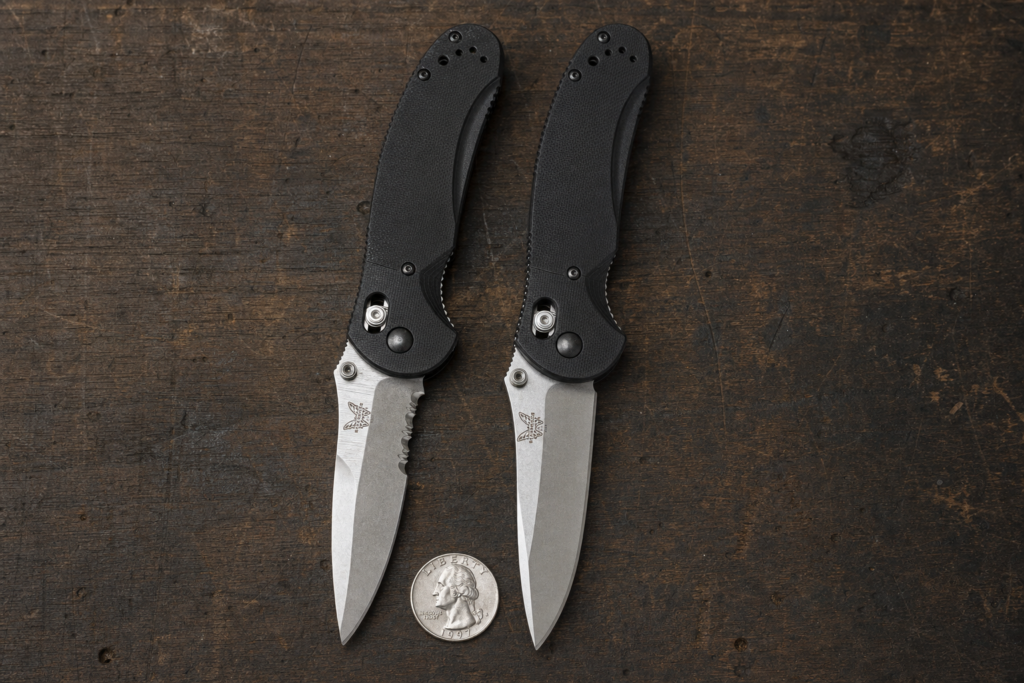
Side-by-side of a serrated combo-blade folder (left) and a plain-edge drop-point folder (right), both with black G10 handles, opened on a workbench with a coin for scale.
Serrated Blade — Pros
- Exceptional at cutting fibrous and synthetic materials (rope, seatbelts, webbing, paracord) under load without a clean draw-cut surface
- Maintains functional cutting ability longer between sharpenings — the teeth continue to bite even when the plain edge portion begins to dull
- Superior for cutting wet or slippery materials where a plain edge tends to skate
Serrated Blade — Cons
- Requires a tapered rod or specialized sharpener (Spyderco Sharpmaker or similar) — no field sharpening on a flat stone
- Teeth catch on clothing, medical gloves, and pockets during the draw, increasing fumble risk under stress
- Precision work (food prep, carving, fine cutting) is effectively impossible with a fully serrated edge
Plain Edge — Pros
- Can be sharpened to a true razor edge on any flat stone, leather strop, or improvised surface in the field
- Versatile across all cutting tasks — food, cordage, carving, medical, utility — with full control over the cut path
- Cleaner, quieter draw from the pocket with no teeth to snag during deployment
Plain Edge — Cons
- Dulls noticeably faster when cutting abrasive or synthetic materials under heavy load
- Requires more frequent stropping and touching up to maintain peak performance in hard-use environments
- Can skip across wet synthetic materials like nylon webbing without a sawing motion
Verdict: For a true collapse-ready environment, the combination blade (partial serration near the spine, plain edge toward the tip) is the most pragmatic compromise — but only on knives with 3.75 inches or more of total blade length where you don’t lose too much of either functional zone. On shorter blades, choose plain edge and accept the maintenance requirement. Recommended platforms: Benchmade Griptilian (plain), Spyderco Paramilitary 2 (plain or combo), CRKT Drifter (combo, budget).
Item 2: The Multi-Tool — 30 Tools You’ll Actually Use
The multi-tool is the compact Swiss Army of collapse preparedness, and unlike a true Swiss Army knife, modern multi-tools are built to take real punishment. Where a pocket knife solves one category of problem brilliantly, the multi-tool solves fifteen categories passably — and in a grid-down scenario, passably is often the difference between functional and broken. You will use the pliers to clamp a fuel line, the wire cutters to splice a battery cable, the saw to breach a window frame, the driver to field-strip a firearm, and the scissors to cut medical tape — often within the same bad afternoon.
The core distinction between entry-level and professional-grade multi-tools is in the pivot tolerances, the steel used in the blades, and the locking mechanisms on individual tools. Cheap multi-tools flex at the plier joint, chip their blade edges on the first serious cut, and deploy with such stiff resistance that you risk losing your grip mid-operation. A professional-grade tool like those from Leatherman or Gerber’s upper lines deploys smoothly, locks positively, and is built to handle hundreds of hard cycles before showing wear.
Weight and profile matter more on a multi-tool than almost any other EDC item because of the carry method. Full-size multi-tools (Leatherman Wave+, Gerber Center-Drive) run 8–10 ounces on the belt — noticeable but manageable. Mid-size tools (Gerber Suspension-NXT, Leatherman Skeletool) shave that down to 5–7 ounces. The key question is whether you need the full suite of drivers and a longer blade, or whether a lighter, more packable option with the core tools (pliers, knife, driver) satisfies 90% of your real-world needs.
Carry method for multi-tools should always be the belt sheath. A multi-tool in a pants pocket is a miserable experience — the weight and bulk defeat most pocket designs and the tool rides low and slow on the draw. A proper Molle-compatible or leather belt pouch keeps it accessible, protected, and ready to deploy without hunting through cargo pockets. Kydex-molded sheaths from manufacturers like Leatherman keep the tool secure even during vigorous movement.
Comparison: Leatherman Wave+ vs. Gerber Suspension-NXT
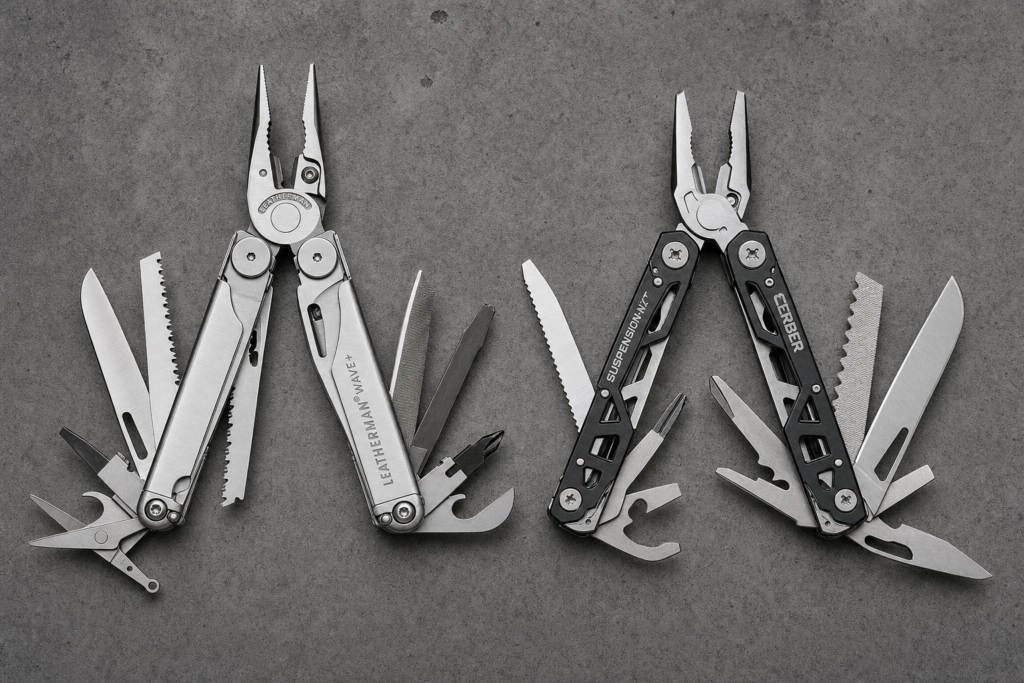
Leatherman Wave+ (left) and Gerber Suspension-NXT (right), both fully deployed on a concrete surface.
Leatherman Wave+ — Pros
- All tools (blades, file, saw, scissors, screwdrivers) lock open individually — a non-negotiable safety feature during heavy use
- Built from 420HC stainless steel with a 25-year warranty; demonstrably more durable under hard daily use than most competitors
- Outside-accessible blades deploy without opening the handles — the Wave+ can be used as a folder knife without the plier chassis open
Leatherman Wave+ — Cons
- At 8.5 ounces and 4 inches closed, it is a full-size EDC commitment — not comfortable in a front pants pocket
- Premium price point (~\$110–\$130 MSRP) creates a real financial barrier
- Requires two hands to deploy most tools — no one-handed operation
Gerber Suspension-NXT — Pros
- Butterfly-open design deploys the plier head fast and intuitively, making it quick to access the primary tool cluster
- Lighter and more compact than the Wave+ (~7 oz, 4.2 inches closed) — sits more comfortably in a belt pouch or cargo pocket
- Lower price point (~\$40–\$55 MSRP) makes it an excellent budget-tier choice without sacrificing the core tool set
Gerber Suspension-NXT — Cons
- Not all tools lock individually — the screwdriver bits are bit-driver dependent rather than dedicated tools
- The blade steel (7Cr17MoV) is softer and dulls faster than the Leatherman’s 420HC under comparable use
- No outside-accessible blade — you must fully deploy the chassis to access the knife
Verdict: If you are outfitting a serious collapse-ready EDC and budget is not the primary driver, the Leatherman Wave+ wins on durability, tool lock safety, and real-world versatility. If you are equipping multiple household members or need a daily carry tool that doesn’t feel like lugging a wrench, the Gerber Suspension-NXT delivers 80% of the capability at half the price and half the bulk. Also worth noting: the Leatherman Skeletool CX splits the difference at ~5 ounces with outside-accessible blade access and genuine Leatherman build quality.
Item 3: The Pistol — Your Last Line of Personal Protection
No collapse-ready EDC is complete without the means to defend yourself and your household. Food, water, and medical supplies are worth exactly nothing if someone with greater capacity for violence can take them from you. The pistol is not the first tool you reach for — de-escalation, evasion, and situational awareness all come before trigger pulls — but when those layers fail, the pistol is what stands between your family and a catastrophic outcome. Carrying a firearm is a serious responsibility that demands training, legal compliance, and a commitment to safe handling practices that never wavers.
The modern service pistol has converged on a remarkably consistent formula: striker-fired, polymer frame, 9mm caliber, 15-round-plus magazine capacity. This configuration dominates because it delivers the best balance of weight, capacity, concealability, reliability, and ammunition availability. In a grid-down scenario, ammunition logistics become a genuine survival consideration — 9mm Luger remains the most commonly manufactured centerfire pistol cartridge on the planet, which means it is the most likely to be found, traded, or resupplied in a prolonged emergency. Selecting a pistol chambered in anything exotic is a choice that will eventually catch up with you in the worst circumstances.
The full-size versus compact debate is the most practical decision the household prepper will make when selecting a carry pistol. Full-size pistols (Glock 17, Sig P320, CZ P-10F) offer longer sight radius, more comfortable shooting with larger hands, and maximum magazine capacity. Compact pistols (Glock 19, Sig P320 Compact, S&W M&P 9 Compact) split the difference — usable in both a duty holster and a concealment holster, with capacity typically in the 15-17 round range. Micro-compact pistols (Sig P365, Springfield Hellcat, Glock 43X) maximize concealability at the cost of capacity and shootability, particularly for smaller-handed shooters.
Training is the variable that eclipses every hardware decision in this section. The best pistol in the world is a paperweight without the muscle memory, sight picture, and decision-making framework built through repetitive, quality range time. If you are new to carrying a firearm, invest in a reputable defensive pistol course (USCCA, NRA Personal Protection, or a local law enforcement-certified instructor) before any other gear purchase. Your skill set is the primary weapon system — the pistol is secondary.
Comparison: Glock 19 Gen 5 vs. Sig Sauer P365
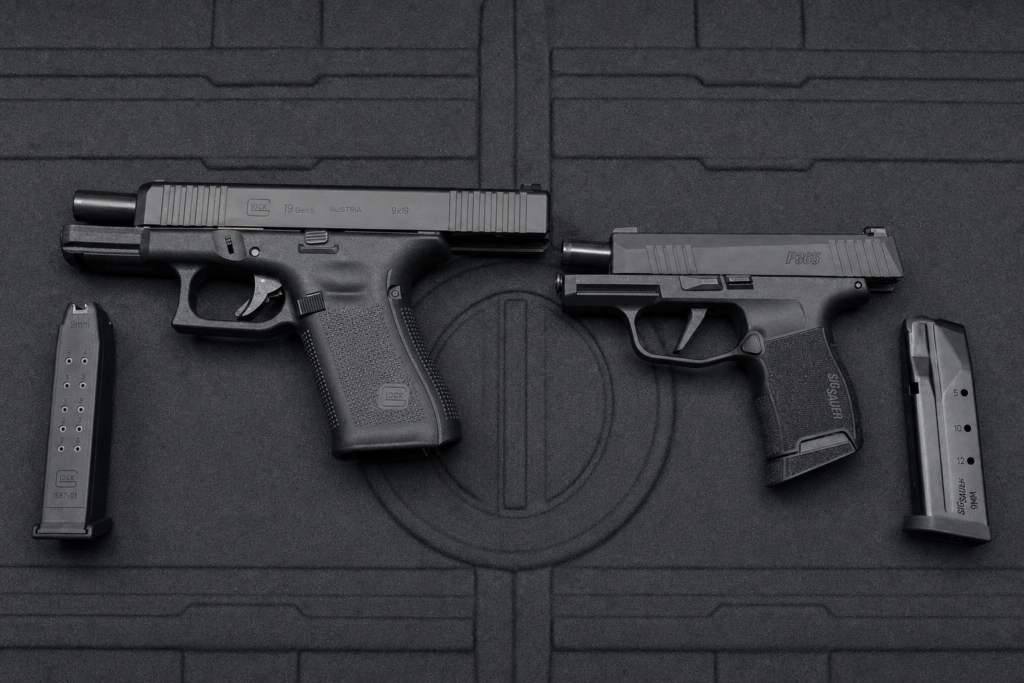
Glock 19 Gen 5 (left) and Sig Sauer P365 (right)
Glock 19 Gen 5 — Pros
- Industry-standard reliability record across millions of rounds in documented field and duty use; replacement parts available globally
- Barrel length (4.02 in.) and sight radius deliver genuinely accurate shooting at distance — a meaningful advantage in a collapse scenario where engagement distance is unpredictable
- Aftermarket ecosystem is the largest of any pistol on earth — sights, triggers, magazine extensions, light mounts, and conversion kits are universally available
Glock 19 Gen 5 — Cons
- At 23.65 ounces loaded, it requires a proper gun belt and a cover garment for concealed carry — not pocket-carry friendly
- Width (1.26 in.) can be challenging to conceal in warm climates or with lighter clothing
- The Glock trigger, while consistent, has a longer travel and reset than premium aftermarket triggers — a training consideration for new shooters
Sig Sauer P365 — Pros
- Industry-leading capacity-to-size ratio: 10+1 standard, 12+1 extended magazine in a package smaller than most single-stack 9mm pistols
- 17.8 ounces loaded — significantly lighter than the G19 and genuinely comfortable in an appendix or pocket carry position
- Excellent factory trigger (SAS trigger) with a shorter reset than many competitors in the micro-compact class
Sig Sauer P365 — Cons
- Grip length limits hand-fill for medium-to-large hands, increasing muzzle flip during rapid fire — manageable but requires deliberate training
- 3.1-inch barrel shortens the sight radius and reduces ballistic performance compared to compact and full-size platforms
- Aftermarket, while growing rapidly, cannot match the Glock ecosystem in depth or geographic availability
Verdict: The Glock 19 remains the single most defensible choice for a collapse-ready household primary carry pistol. Its reliability data, parts ecosystem, and training applicability represent a nearly unassailable combination of practical advantages. The Sig P365 earns its place as the best-in-class micro-compact for household members who will not tolerate the full-size carry footprint — particularly for female preppers, smaller-framed individuals, or anyone in a warm-weather, light-clothing environment. The ideal household battery is one Glock 19 per adult as the primary, with P365s or similar micro-compacts as backup or pocket carry.
Item 4: The Holster — Carrying Safely and Accessibly
A pistol without the right holster is either dangerous, inaccessible, or both. The holster is not an afterthought — it is the primary interface between your body, your daily activity, and your defensive tool. It determines whether your draw is smooth or fumbled, whether your trigger is protected or exposed, and whether you can sustain a comfortable carry that doesn’t create physical pain or wardrobe limitations after six hours of wear. Cheap nylon holsters with poor retention, flexible trigger guards, and no cant adjustment have no place in a serious EDC. Full-coverage, rigid-construction holsters with a defined retention level are the minimum standard.
Inside-the-waistband (IWB) carry places the holster between your body and your pants, inside the waistband. This method is the dominant choice for concealed carry because it dramatically reduces the visible profile of the pistol — even a full-size Glock 19 disappears under a standard untucked shirt in a quality IWB. The trade-off is comfort: the holster and pistol press against your body, which demands either a slight waistband size increase (typically 1–2 inches) or a slim-profile holster to avoid rubbing. Kydex is the dominant material in modern IWB holsters because it holds its shape under sweat, heat, and physical activity, provides an audible click-retention when holstering, and can be molded to trigger-guard specs precise enough to prevent any possibility of trigger contact.
Outside-the-waistband (OWB) carry places the holster on the outside of the pants, on the belt. This is the natural carry method for open carry, range use, tactical vests, and duty applications. OWB holsters allow faster draws because the pistol sits farther from the body with a natural hand-index angle. They are significantly more comfortable for full-size pistols and for extended carry periods — particularly in vehicles, where an IWB can dig into the hip under a seatbelt. The primary OWB trade-off is concealability: unless you’re wearing a longer jacket or a purpose-built cover garment, the pistol will print or flag below your clothing.
Retention level is a frequently overlooked decision factor. Level I retention (passive friction only) is appropriate for everyday concealed carry in low-threat environments. Level II retention (a button or hood release in addition to friction) is appropriate for open carry or environments with elevated risk of weapon retention problems. Level III (a secondary mechanical lock) is duty-grade and generally impractical for civilian EDC because of the draw speed penalty. For collapse-ready household carry, Level I retention Kydex IWB or OWB covers the overwhelming majority of scenarios.
Comparison: IWB (Inside-the-Waistband) vs. OWB (Outside-the-Waistband)
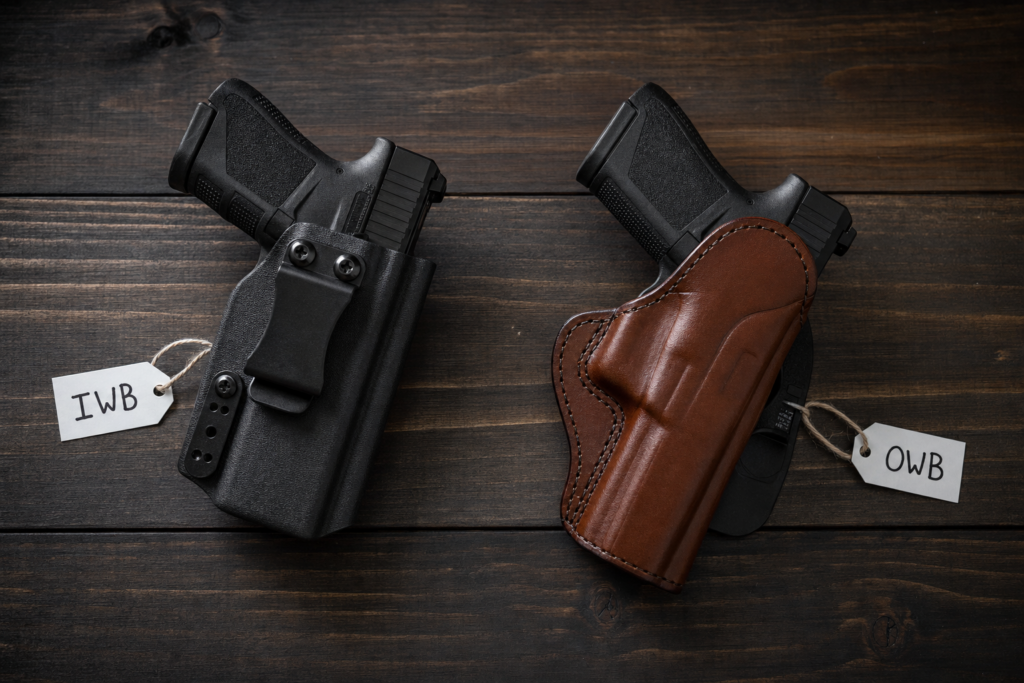
Black Kydex IWB holster (left) vs. brown leather OWB holster (right)
IWB Holster — Pros
- Superior concealment — even full-size pistols disappear under normal street clothing without a purpose-built cover garment
- Single belt anchor (clip or claw) creates a low-profile setup that works with most civilian wardrobe options
- Appendix IWB (AIWB) position provides the fastest possible draw stroke and natural presentation to threat
IWB Holster — Cons
- Physical contact with the body creates comfort challenges during extended sit-down carry, particularly with larger pistols
- Reholstering with a loaded firearm in an IWB is the highest-risk moment in the carry cycle — clearing clothing before holstering is non-negotiable
- Waistband sizing must be adjusted; existing pants may not accommodate the additional inch or more of girth without pinching
OWB Holster — Pros
- Significantly more comfortable for extended carry, vehicle carry, and work environments where physical activity is continuous
- Natural, consistent draw angle with easy hand-to-grip index — advantageous for higher-frequency access scenarios
- Better suited for full-size and duty pistols where IWB bulk becomes genuinely problematic
OWB Holster — Cons
- Concealment requires a longer cover garment — a fleece, jacket, or untucked flannel shirt in most configurations
- In open-carry states, OWB creates a visible deterrent signal — which can be desirable or a tactical liability depending on the environment
- Higher-quality OWB holsters (Safariland, Blackhawk Serpa) add retention levels that slow the draw compared to basic friction-fit IWB
Verdict: For the collapse-ready EDC, Kydex IWB in either the 3–4 o’clock or appendix position is the gold standard for concealed daily carry. Recommended makers: Vedder LightTuck, Tier 1 Concealed, JM Custom Kydex. If your primary carry context involves open carry, vehicle operations, or a duty-style setup, OWB in Level II from Safariland (6378 RDS or ALS series) provides the most dependable retention-to-draw balance available. Never mix holster types without verifying retention and trigger coverage with an unloaded firearm before going live.
Item 5: The Tactical Flashlight — Light as Tactical Advantage
In a collapse scenario, darkness is not an inconvenience — it is a force multiplier for anyone who wants to exploit your lack of situational awareness. Power outages, structural failures, vehicle breakdowns at night, and interior searches of compromised buildings all demand reliable, high-output illumination that fits in your pocket. The modern EDC flashlight is a compact, rechargeable or easily-batterable device capable of producing hundreds of lumens from a form factor smaller than a pen. Beyond navigation, a tactical flashlight temporarily blinds a threat when directed at the eyes from close range, assists in identifying hazards before committing to movement, and serves as an impact tool in an absolute last resort.
Lumen output is the headline specification, but it is not the whole story. A 1,000-lumen flashlight with a flooded beam pattern illuminates a 10-foot radius beautifully but throws almost nothing at 50 yards. A 500-lumen flashlight with a tightly focused hot spot will illuminate a threat at 100 yards while a broad-beam competitor is still trying to find it. For EDC, the most useful specification is the combination of a usable turbo mode (300+ lumens for active threat identification) and a lower everyday mode (20–80 lumens) that preserves battery life and night vision during extended navigation. Dual-fuel compatibility — running on both rechargeable 18650 cells and disposable CR123As — is a significant logistical advantage in a collapse environment where only one type may be available.
Runtime at turbo is almost universally overstated by manufacturers, and understanding this prevents operational failures. Most compact tactical lights will sustain true turbo output for 30–90 seconds before thermally stepping down to protect the LED and emitter housing. This is by design and not a defect — it means turbo is a weapon of momentary opportunity, not sustained operation. For lighting your way through a compromised structure, mid-mode at 150–300 lumens with multi-hour runtime is the actual working spec.
Battery standardization across your household EDC kit reduces cognitive load in emergencies. If your flashlight, backup light, and weapon-mounted light all use the same 18650 or CR123A format, you carry one spare battery type and can cross-feed across tools. This seems minor until it isn’t.
Comparison: Streamlight ProTac 1L-1AA vs. Fenix PD36R
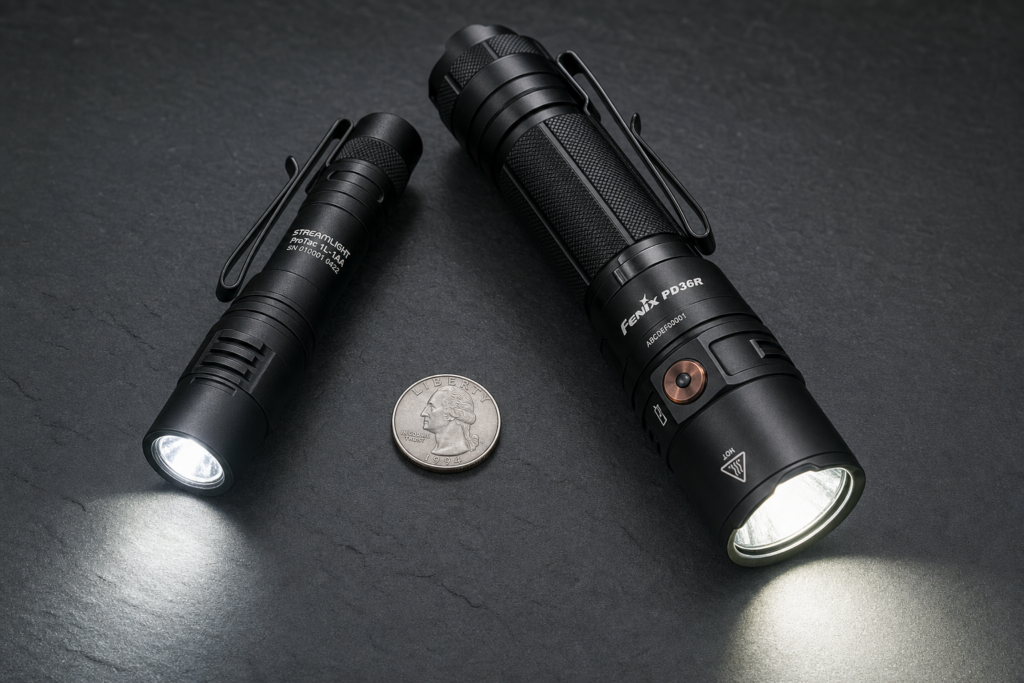
Streamlight ProTac 1L-1AA (left) and Fenix PD36R (right)
(coin for scale)
Streamlight ProTac 1L-1AA — Pros
- Dual-fuel compatibility (CR123A or standard AA) gives it the broadest possible sourcing options in a collapse supply chain
- Extremely compact (3.39 in., 2.4 oz.) — comfortable in any pocket without printing or discomfort
- Ten-Tap programmable mode configuration allows the user to set a preferred output sequence for their specific use case
Streamlight ProTac 1L-1AA — Cons
- Maximum 350 lumens on CR123A is functional but not impressive by current standards — insufficient for long-range target identification
- No USB-C recharging — requires spare batteries or an external charger; a meaningful logistical friction point
- Single switch interface can require mode cycling to reach desired output under stress — muscle memory is required
Fenix PD36R — Pros
- 1600 lumen turbo output (USB-C rechargeable, 21700 cell) represents a meaningful step up in identification capability at distance
- USB-C direct charging with a red/green charge indicator means one cable charges the light in your pocket — no separate charger required
- Side switch + tail switch dual-switch design allows instant access to turbo (tail) and mode selection (side) simultaneously
Fenix PD36R — Cons
- Single proprietary 21700 battery format with no AA backup — if the cell dies with no charger available, the light is non-functional
- Larger form factor (5.2 in., 3.3 oz.) prints in lighter pants pockets and is more bulky for all-day carry
- Higher price point (~\$75–\$90 MSRP) compared to the Streamlight (~\$35–\$50)
Verdict: For the primary EDC flashlight in a collapse-ready kit, the Fenix PD36R wins on raw capability and the convenience of USB-C direct charging in any scenario where power is intermittently available. For a backup light, vehicle glove box, or bug-out bag supplemental light where dual-fuel flexibility matters more than peak output, the Streamlight ProTac 1L-1AA is nearly unbeatable at its price point. Every collapse-ready household member should have at minimum one light per person — two is better.
Item 6: The Tourniquet — Stop the Bleed Before Help Arrives
No medical item has more documented life-saving data behind it than the tourniquet. TCCC (Tactical Combat Casualty Care) protocols developed through 20 years of combat medicine in Iraq and Afghanistan have conclusively demonstrated that properly applied tourniquets save lives from extremity hemorrhage — and that the window for effective application is measured in minutes, not hours. In a collapse scenario where EMS response times become unpredictable or nonexistent, the ability to control massive bleeding from your own body or a family member’s is not a medical luxury — it is a fundamental survival capability.
The modern carry tourniquet is designed for self-application with one hand, which is its defining engineering requirement. This demands a specific mechanical design: a windlass system (a rigid rod that twists a strap around the limb to achieve occlusion pressure) or a pneumatic/ratcheting system that can be tightened with one hand without slipping. Both the CAT (Combat Application Tourniquet) and SOFTT-W (Soft-T Wide) achieve this through slightly different mechanisms. The CAT uses a single strap with a friction buckle and windlass rod; the SOFTT-W uses a dual buckle system with a wider band for better pressure distribution on larger extremities.
Proper training in tourniquet application is as mandatory as carrying the device itself. An improperly applied tourniquet — too loose to achieve vascular occlusion, improperly positioned (too far from the wound), or applied over a joint — can be worse than no tourniquet at all by wasting critical application time and creating a false sense of security. Organizations like Stop the Bleed (a national trauma intervention initiative), the Red Cross, and most TCCC/TECC civilian training courses offer hands-on application training. Purchase a dedicated training tourniquet for practice — never manipulate your carry tourniquet unless it is being applied in an actual emergency.
Carry position for the tourniquet matters operationally. Medical professionals recommend the outside of a belt, cargo pocket, or dedicated MOLLE medical pouch on the dominant-hand thigh — positions that allow rapid access with either hand and don’t require excavating a bag. The tourniquet should be on your person, not in a bag. If it’s in the pack and the pack is in the car, it isn’t part of your EDC.
Comparison: CAT Gen 7 vs. SOFTT-W
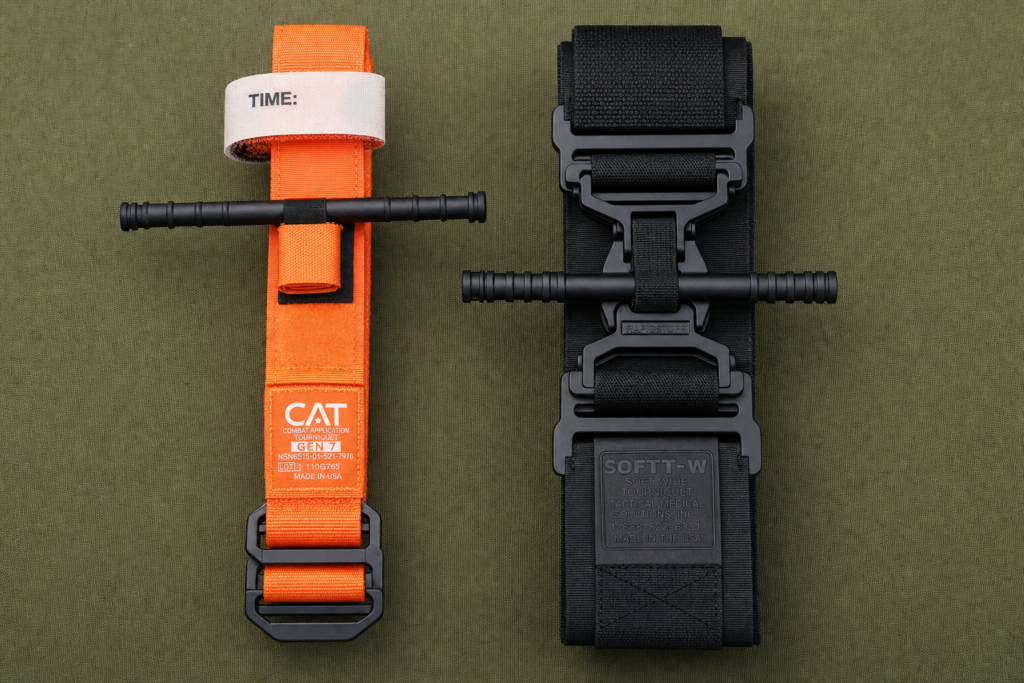
CAT Gen 7 in orange (left) and SOFTT-W in black (right)
CAT Gen 7 — Pros
- The most clinically studied tourniquet in history — validated in peer-reviewed trauma literature across thousands of documented applications in combat and civilian EMS settings
- Single-strap windlass system with a low self-application learning curve — most users achieve functional one-handed occlusion after minimal training
- Available in blaze orange for maximum visual identification during casualty assessment — important when multiple responders are triaging a scene
CAT Gen 7 — Cons
- 1.5-inch band width concentrates pressure more narrowly than wider alternatives — can cause tissue trauma and increased discomfort on very muscular or obese extremities requiring very high occlusion pressure
- The windlass rod has a known failure mode under extreme cold when the plastic becomes brittle — a relevant concern for cold-climate preppers
- Counterfeit CATs are extraordinarily common; purchase only from verified distributors (North American Rescue, TacMed Solutions) — a fake CAT can fail catastrophically under load
SOFTT-W — Pros
- 1.5-inch wide strap with an integrated metal buckle system distributes pressure more evenly than the CAT, reducing tissue damage in extended wear scenarios (transport times greater than 2 hours)
- Metal windlass rod is more durable under thermal extremes than the CAT’s polymer rod — significant advantage in cold-weather operations
- Dual-ring buckle system provides a secure secondary lock point that prevents windlass unraveling during patient transport
SOFTT-W — Cons
- Slightly bulkier profile makes it less ideal for compact EDC pouches or flat-folded carry configurations
- The dual-buckle application process has a marginally steeper one-handed application learning curve than the CAT — requires deliberate repetition to build muscle memory
- Lower overall name recognition means less interoperability training with bystanders — in a mass casualty scenario, a passer-by told “apply the tourniquet” is more likely to know the CAT by sight and function
Verdict: For primary EDC, carry the CAT Gen 7 (from a verified distributor) for its documented clinical performance and one-handed application simplicity. For extended wilderness or cold-weather scenarios where durability and pressure distribution over extended transport times are paramount, the SOFTT-W earns its place. Ideally, both should be present in a complete household trauma kit alongside a SWAT-T backup and a commercial bleeding control kit (Israeli bandage, hemostatic gauze, chest seals).
Item 7: The Ferro Rod — Fire on Demand, Without Batteries
Fire is the oldest survival technology in human history, and in a collapse scenario it becomes one of the most critical. Fire means warmth against hypothermia, sterilization for water and instruments, cooking for food safety, signaling for rescue, and morale — the psychological value of a fire in a dark and uncertain situation is measurable and significant. Every collapse-ready EDC should include a reliable, weather-independent fire-starting device that does not depend on chemical fuel, battery charge, or perfect environmental conditions to function. The ferro rod — ferrocerium striker — satisfies all of those requirements with a simplicity and durability that lighter-based alternatives cannot match.
A ferro rod works by scraped friction: a steel striker removes tiny particles of ferrocerium alloy at high speed, which oxidize instantaneously at temperatures around 3,000°F when exposed to air. These sparks are hot enough to ignite a wide range of dry tinders — cotton balls prepared with petroleum jelly, jute twine, fine wood shavings, dried grass, and commercially prepared fatwood shavings — even in damp and windy conditions where a lighter would fail. A quality ferro rod will produce thousands of strikes before it is expended, making it essentially an indefinite-use device over any realistic preparedness timeline.
Rod diameter is the primary specification that governs both longevity and ease of use. Standard EDC ferro rods run 3/8-inch diameter — enough material for thousands of strikes with comfortable grip. Larger rods (1/2-inch to 5/8-inch) aimed at wilderness and survival use produce bigger spark showers more easily and last even longer, but add bulk to a pocket carry setup. For EDC, the 3/8-inch format in a 4- to 5-inch length is the practical standard. The striker tool should be rigid metal (a fixed blade spine, a dedicated scraper, or a high-carbon steel piece) rather than the soft metal pseudo-strikers some kits include that produce inadequate sparks.
Pairing the ferro rod with pre-prepared tinder is what separates a functional fire kit from a piece of gear theater. Petroleum jelly-saturated cotton balls compressed into a waterproof capsule are the gold standard: they ignite from a single spark strike, burn for 2–4 minutes, and cost pennies to produce. Carry three in a small aluminum waterproof capsule alongside your ferro rod and your fire capability becomes essentially unconditional. Commercial alternatives like WetFire tinder cubes and Tinder-Quik tabs perform similarly and require no preparation, at higher cost per use.
Comparison: Überleben Zünden vs. Light My Fire Scout
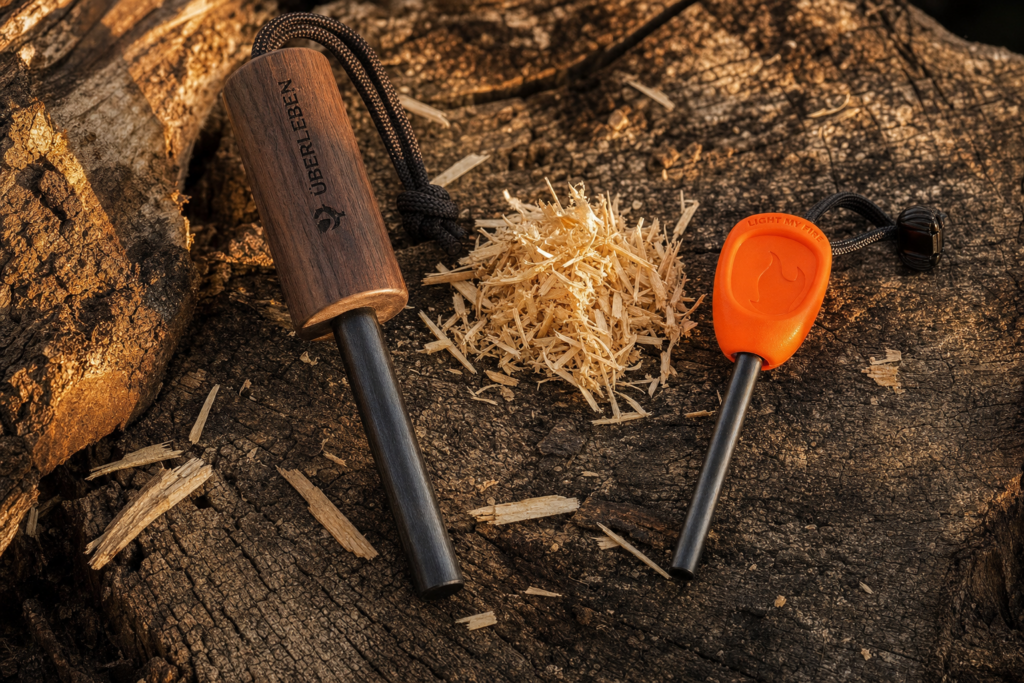
Überleben Zünden with walnut handle (left) and Light My Fire Scout with orange handle (right)
Überleben Zünden — Pros
- 1/2-inch diameter rod in the large configuration produces an exceptionally generous spark shower — forgiving for beginners and reliable for expert users in adverse conditions
- Genuine wood handle (walnut, curly maple, or stabilized options) provides superior grip in wet gloved hands compared to smooth polymer handles
- Includes a dedicated high-carbon steel striker that is genuinely functional — not a decorative scraper
Überleben Zünden — Cons
- Wood handle adds bulk and weight compared to compact polymer alternatives — the large format is better suited to a bug-out bag than a daily pocket carry
- Price point (~\$25–\$40) is higher than utilitarian competitors for what is mechanically a simple device
- Lanyard attachment loop can snag in a pocket — minor but worth taping over for tight carry configurations
Light My Fire Scout — Pros
- Compact and lightweight — the Scout BIO (bio-based polymer handle) runs approximately 1.2 ounces and 4 inches total, making it a genuine EDC pocket-carry option
- Bright safety orange handle is visible when dropped in grass, mud, or snow — a practical advantage in field use
- The integrated whistle on the Scout handle adds a secondary signaling capability at no weight penalty
Light My Fire Scout — Cons
- 3/8-inch rod diameter is serviceable but produces a more modest spark shower than larger-format competitors — requires better tinder preparation and technique
- The plastic striker/scraper included with many Scout configurations is less effective than a dedicated steel scraper — replace it with a piece of hacksaw blade
- More limited longevity than large-format rods; heavy users may exhaust a Scout rod in 12–18 months of regular practice use
Verdict: For dedicated EDC pocket carry, the Light My Fire Scout wins on compactness and visibility. Add a piece of hacksaw blade as a dedicated striker to address its one real weakness and it becomes a highly capable everyday fire kit. For bug-out bags, vehicle kits, and base-camp fire kits where bulk is not a limiting factor, the Überleben Zünden in the large format is one of the most satisfying and effective ferro rods available at any price point. Never carry a ferro rod without accompanying tinder — the tool without the fuel is half a fire kit.
Building Your Complete Collapse-Ready EDC Stack
These seven items form a coherent, layered response capability across the most likely collapse-scenario threat categories:
| Category | Item | Recommended Choice |
| Utility / Defense | Pocket Knife | Spyderco PM2 (plain) / Benchmade Griptilian (combo) |
| Utility / Field Repair | Multi-Tool | Leatherman Wave+ |
| Personal Protection | Pistol | Glock 19 Gen 4 or 5 |
| Carry System | Holster | Kydex IWB (Vedder / JM Custom) |
| Navigation / Defense | Flashlight | Fenix PD36R (primary) + Streamlight ProTac (backup) |
| Medical | Tourniquet | CAT Gen 7 (North American Rescue) |
| Survival | Ferro Rod | Light My Fire Scout + petroleum jelly tinder |
The total loaded weight of this stack — knife, multi-tool, pistol and holster, flashlight, tourniquet, ferro rod — runs approximately 2.8 to 3.5 pounds depending on the specific pistol and holster configuration. That weight is distributed across belt, pockets, and dedicated carry positions, and it becomes invisible within days of consistent carry. The stack covers cutting, repair, defense, signaling, medical, and fire — five of the six core survival categories — without a bag. Add water filtration (a Sawyer Squeeze or LifeStraw in a cargo pocket) and you’ve covered the sixth.
Carry everything. Carry it every day. The emergency that catches you without your kit is the one that defines your outcome.
— When Systems Fail — We Don’t.