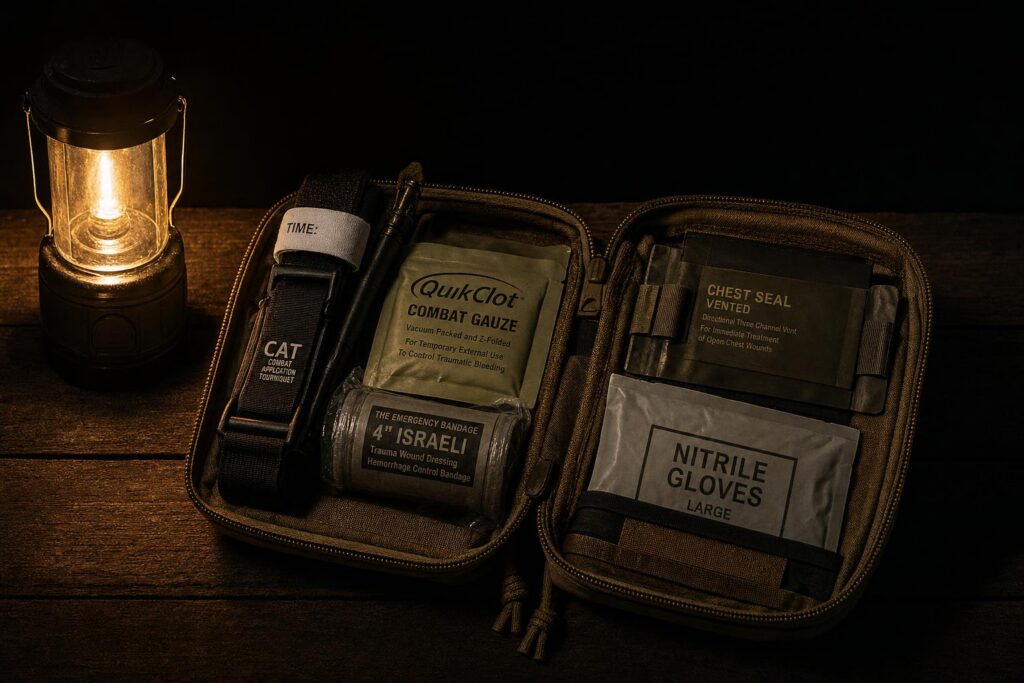
Medical and Trauma Gear Recomendations
Medical and Trauma Gear Recommendations
When things go wrong, they go wrong fast. In a real emergency—whether it’s a household accident, a regional disaster, or a full‑scale collapse scenario—medical capability becomes one of the most decisive factors in survival. You can have food, water, tools, and a solid plan, but without the ability to stop bleeding, stabilize injuries, and manage trauma, everything else can fall apart in minutes.
This section breaks down the medical and trauma gear that every collapse‑ready household should have on hand. The focus here is not just on exotic surgical kits or field procedures, but on proven, field‑tested equipment that dramatically increases survivability when professional help is delayed or unavailable. From tourniquets and pressure dressings to wound‑care essentials and austere‑environment medical tools, these recommendations are built around reliability, durability, and real‑world effectiveness.
Your goal is simple: build a medical capability that buys time, preserves life, and keeps your people in the fight. The gear listed here forms the backbone of that capability.
Subscribe on your favorite platform
Trauma Kit Recomendation
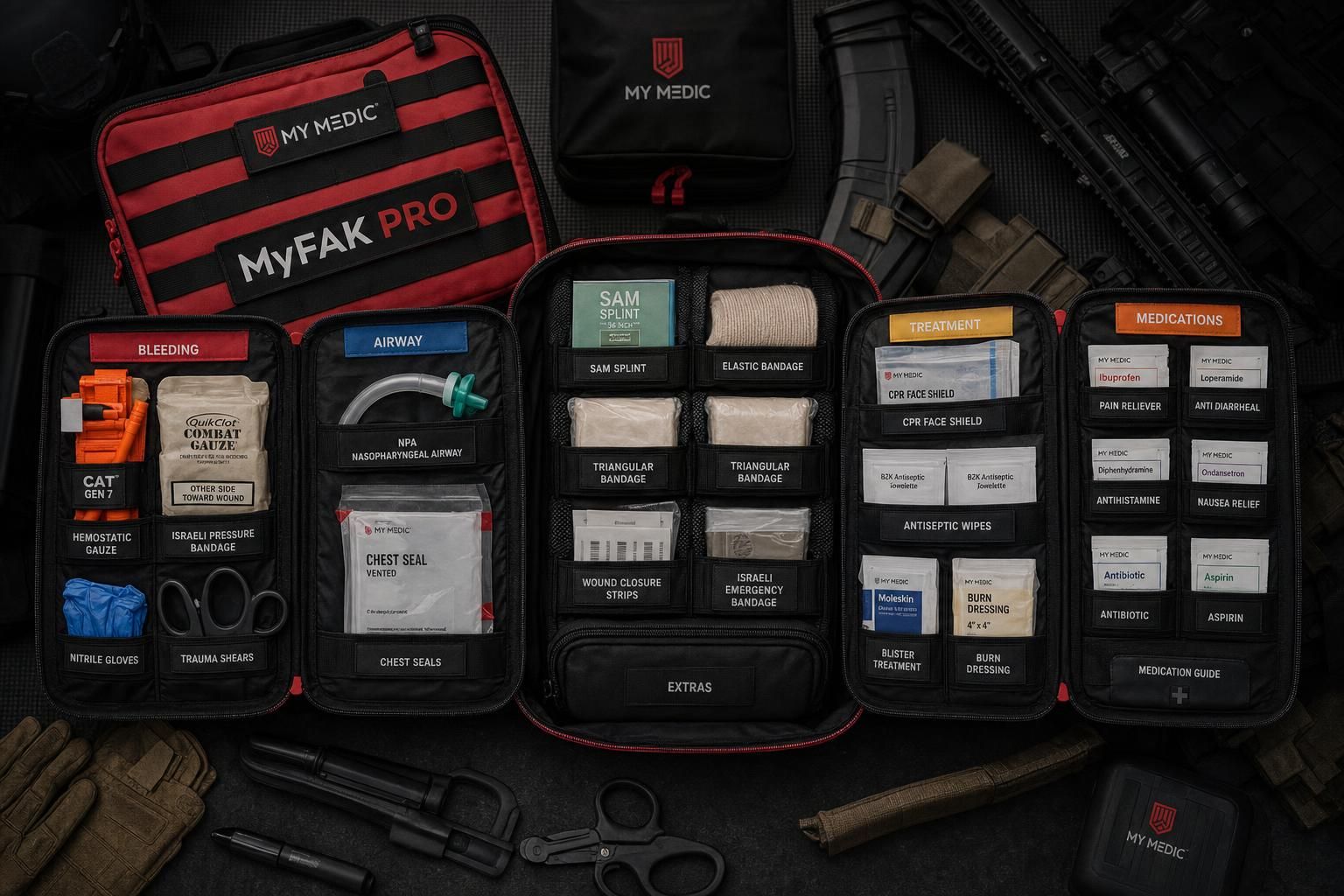
GEAR REVIEW: MyMedic MyFAK Pro Trauma & Medical Kit
The Collapse Ready Household Field Assessment
Retail Price: $199–$249 (direct from MyMedic.com and Amazon)
Made in: USA
Weight: ~5.5 lbs (fully stocked)
Warranty: Lifetime
HSA/FSA Eligible: Yes
Overview
If there is one purchase you make for your household medical preps that will immediately move the needle from “first aid” to “trauma capable,” the MyMedic MyFAK Pro is the kit to beat in the sub-$250 price tier. Built in Utah and backed by a lifetime warranty, the MyFAK Pro bridges the gap between a consumer drugstore kit and a professionally staged jump bag. It won’t replace a full medic’s ruck, but in a grid-down, delayed EMS, or active-threat scenario — it’s the difference between life and death, and that is not hyperbole.
This review covers the full contents, real-world performance based on verified user testing and field-use accounts, and an honest assessment of where the kit earns its price tag and where it comes up short.
The Bag & Platform
The MyFAK Pro arrives in a rugged 1000D nylon tactical shell with a full-length MOLLE panel on the back face, allowing it to mount to a vehicle headrest, a pack, a plate carrier, or a wall-mounted panel. It is not waterproof on its own — the contents are not individually vacuum-sealed — so you’ll want to store it out of standing water environments or add a simple rain cover.
The folding “book page” interior design is the standout feature of this kit versus any roll-pouch or clamshell design. The kit opens like a binder, with individual laminated divider panels that fold out and stay open, giving you clean visual access to every item without digging or dumping. Under stress, with shaking hands, this design pays dividends. First-time users who have practiced even once can locate items with peripheral vision alone.
Metal snap clips secure the panels closed. These have proven durable across reported drops, vehicle storage, and repeated daily opening in training contexts. Cheaper kits use plastic snaps that fail under thermal cycling — not an issue here.
Contents — Full Inventory Breakdown
The MyFAK Pro ships with 146 medical-grade items organized into functional categories. Below is the breakdown:
🩸 Hemorrhage Control (The Core of Any Trauma Kit)
| Item | Qty | Notes |
|---|---|---|
| RATS Tourniquet | 1 | Rubber Application Tourniquet System — controversial but fast to deploy |
| QuikClot Combat Gauze (Hemostatic) | 1 roll | Z-fold; 3″ × 4 yards — impregnated with kaolin clay |
| Israeli Emergency Pressure Bandage | 1 | 4″ — the gold standard pressure dressing; can be self-applied |
| Elastic Bandage | 2 rolls | Reinforcement wrapping post-packing |
| Wound Closure Strips | 20 strips | Steri-strip style, 1/4″ × 3″ |
| Trauma Gauze (plain) | 2 rolls | Secondary packing material |
Field Notes on Hemorrhage Control: The hemostatic gauze is mission-critical. QuikClot Combat Gauze is military-issue and has been validated in battlefield use for over a decade. Kaolin-impregnated gauze activates clotting factors on contact — tested in pig-liver laceration models and in actual combat casualty records from Iraq and Afghanistan. In community real-world use (hunting accidents, chainsaw injuries, motor vehicle trauma), this gauze has reliably bought patients the time they needed to reach a surgeon. The Israeli bandage is similarly pedigreed — it remains the simplest one-handed pressure bandage on the market.
Note on the RATS Tourniquet: This is a polarizing item. It works, but it requires specific technique and is not TCCC (Tactical Combat Casualty Care) compliant. Many experienced medics recommend replacing it with a CAT Gen 7 or SOFTT-W tourniquet, both of which are windlass-style and allow one-handed application on a limb. The upgrade runs ~$30. Do it.
🫁 Airway Management
| Item | Qty | Notes |
|---|---|---|
| Nasopharyngeal Airway (NPA), 28Fr | 1 | With lubricant packet |
| CPR Face Shield (barrier) | 1 | Keychain-style, single-use |
Field Notes: The NPA is a legitimate airway adjunct that can keep an unconscious patient breathing when manual positioning alone fails. Its inclusion in a civilian kit is noteworthy — most consumer kits omit it entirely. However, NPA use requires training. If you haven’t practiced insertion on a mannequin or simulation trainer, add this to your next Stop the Bleed or Wilderness First Responder (WFR) training objective. The CPR face shield is appropriate but minimal; the absence of a bag-valve mask (BVM) is the gap in this category.
🩻 Chest Trauma
| Item | Qty | Notes |
|---|---|---|
| Hyfin Compact Chest Seal (vented) | 2 | One per side for a penetrating chest wound |
Field Notes: Vented chest seals are the correct choice for penetrating thoracic trauma. They allow air to exit and prevent tension pneumothorax — one of the fastest killers in gunshot or stab wound scenarios. The Hyfin Compact is a proven product. Two seals allows you to treat both the entry and exit wound simultaneously, which is TCCC doctrine. This is a high-value inclusion that many kits in this price range completely omit.
🦴 Musculoskeletal / Immobilization
| Item | Qty | Notes |
|---|---|---|
| SAM Splint (36″) | 1 | Moldable aluminum core, foam padded |
| Triangular Bandage (sling) | 2 | With safety pins |
| Elastic Bandage (ACE-style) | 2 rolls | Dual use — splint wrap and compression |
Field Notes: The SAM splint is a legitimate immobilization tool for suspected fractures of the wrist, forearm, ankle, and lower leg. It is military-issue and widely used by Search and Rescue (SAR) teams and wilderness medicine practitioners. For femur (thigh) fractures, you will need a traction splint — not included and a realistic gap for a home kit of this size. The triangular bandages are multi-purpose: sling for shoulder/arm injuries, improvised pressure bandage, tourniquet backup, and eye covering.
🔥 Burn Treatment
| Item | Qty | Notes |
|---|---|---|
| Burn Gel Dressing | 1 | Water-based, hydrogel-soaked pad |
| Sterile Non-Adherent Dressing | 2 | For secondary burn covering |
Field Notes: The burn dressing provides cooling and pain relief for minor-to-moderate burns. It is not sufficient for major burns covering large body surface area (BSA) — for those scenarios you need large roll gauze and dry sterile covering to prevent hypothermia. For a household kit, the burn dressing handles the most statistically common burn scenario: kitchen burns, campfire contact, or fuel spills.
💊 Medications & OTC Interventions
| Item | Qty | Notes |
|---|---|---|
| Aspirin (325mg) | 4 tabs | Cardiac event protocol — chew, don’t swallow |
| Ibuprofen (200mg) | 8 tabs | Pain/inflammation |
| Diphenhydramine (Benadryl, 25mg) | 4 tabs | Antihistamine — allergic reaction |
| Antacid tablets | 4 tabs | GI support |
| Non-Latex Nitrile Gloves | 2 pairs | Personal protective equipment |
Field Notes: The aspirin inclusion for cardiac events is an underrated feature. In a collapse scenario where ambulances are unavailable, chewing 325mg of aspirin at onset of suspected MI symptoms has strong evidence behind it. Benadryl addresses mild-to-moderate allergic reactions. Epinephrine auto-injector (EpiPen) is NOT included and is the most critical gap for households with known anaphylaxis risk — discuss with your physician and keep one in the kit.
🔧 Tools & Accessories
| Item | Qty | Notes |
|---|---|---|
| EMT / Trauma Shears | 1 | 7.25″ spring-loaded |
| Penlight (LED) | 1 | Pupil assessment, wound inspection |
| Medical Tape (cloth) | 1 roll | 1″ wide |
| Antiseptic Wipes | 10 | Pre-packaged, BZK-based |
| Alcohol Prep Pads | 10 | Tool/surface sanitization |
| Irrigation Syringe (20cc) | 1 | Wound flushing |
| Blister Treatment Kit | 1 set | Moleskin pads + hydrocolloid |
| Safety Pins | 6 | Multiple sizes |
| Emergency Blanket (space blanket) | 1 | Thermal shock prevention |
Field Notes: The EMT shears are adequate but mid-grade — they’ll cut through clothing and seat belts but not heavy denim or tactical webbing without effort. Upgrade to a Leatherman Raptor or dedicated heavy-duty shear if budget permits. The irrigation syringe for wound flushing is an excellent inclusion — proper high-pressure irrigation (30cc syringe, 18ga catheter tip) has stronger evidence for infection prevention than antiseptic wipes in wound care protocols.
Real-World Performance Assessment
Stop the Bleed Scenarios (Hemorrhage)
The core trauma supplies — hemostatic gauze, chest seals, pressure bandage, and NPA — are field-proven and reflect current TCCC and TECC (Tactical Emergency Casualty Care) doctrine. In verified civilian accounts (hunting accidents, ATV trauma, power tool injuries), hemostatic gauze combined with a well-applied pressure bandage has repeatedly maintained patient stability for 30–90 minutes until EMS arrival. Grade: A
Multi-Casualty / Extended Care Limitation
One kit handles one patient to casualty-care standards. Quantities are calibrated for a single serious trauma. In a household of 4–6, two kits are the minimum. Grade: Adequate for the price tier
Organization Under Stress
The folding page system earns high marks from EMS professionals who have evaluated it. Comparable kits — clamshell designs, dump pouches — force users to excavate. The MyFAK’s visual clarity under stress is a measurable life-safety advantage. Grade: A
Shelf Life of Contents
Medications: 2–4 years from manufacture. Hemostatic gauze: 5 years. Chest seals: 5–7 years. The kit does not ship with an itemized expiration date card — you’ll need to create one (a single index card taped inside the cover works fine) and set a calendar reminder for annual inspection. Grade: B-
Value vs. Build-Your-Own
Assembling an equivalent kit from individual components (CAT tourniquet, QuikClot, Hyfin seals, SAM splint, NPA, shears, pressure bandage) costs between $175–$220 without the bag and organization system. The MyFAK Pro delivers a pre-organized, lifetime-warranted platform at a comparable cost — and includes the bag, the training course access, and the organizational infrastructure. Grade: A-
Collapse Ready Assessment — What to Add
For the Collapse Ready Household, the kit as shipped is an excellent starting point. Add the following to reach a fully capable level:
- CAT Gen 7 Tourniquet — Replace or supplement the RATS. (~$30)
- EpiPen (Rx) — Critical for anaphylaxis-prone households. (Prescription required)
- SAM Pelvic Sling — Pelvic fracture stabilization in MVA scenarios (~$25)
- Quikclot Bleeding Control Bandage (additional) — Two hemostatic gauze rolls are better than one for multi-wound or high-volume bleeds (~$20)
- Written Treatment Protocol Cards — Laminated pocket reference (available free from StopTheBleed.org)
- Suture/Staple Kit — For extended care scenarios beyond 24 hours from surgical reach (~$15–$30)
Pros and Cons
✅ PROS
- Trauma-capable out of the box — chest seals, hemostatic gauze, NPA, and pressure dressings reflect actual TCCC doctrine, not just consumer-grade bandages
- Folding page organization system is the best in class at this price point for access under stress
- Built in the USA with a lifetime warranty — meaningful long-term value
- HSA/FSA eligible — reduces effective out-of-pocket cost
- MOLLE-compatible — mounts to vehicle headrests, pack frames, wall panels, and plate carriers
- Free online training course included with purchase — adds genuine value for non-medically trained users
- Burn treatment, blister care, and aspirin protocol included — covers the statistically common household emergencies alongside trauma scenarios
- Irrigation syringe included — critical for wound infection prevention and rarely seen at this price tier
- Aspirin protocol for cardiac events — underappreciated but potentially life-saving
❌ CONS
- RATS Tourniquet is a downgrade from CAT/SOFTT-W — acceptable for trained users, but windlass-style is the gold standard and requires a $30 supplemental purchase
- Not waterproof — contents can be compromised by flooding, vehicle leaks, or high-humidity storage; individual bagging is needed for wet environments
- No EpiPen / epinephrine — the gap between diphenhydramine and anaphylaxis management is life-threatening; households with severe allergies must supplement
- No BVM (bag-valve mask) — airway management is limited to NPA + face shield; adequate but not full ALS-adjacent capability
- Single-patient supply quantities — not designed for multi-casualty scenarios without a second kit
- No itemized expiration date card included — requires owner to track and rotate supplies manually
- Penlight is minimal — works for pupil checks but a headlamp is more practical in a real trauma scenario
- No pelvic binder — a significant gap for vehicle accident scenarios
- Price fluctuates — occasionally exceeds the $250 upper limit on some retail platforms; buy direct from MyMedic.com for best pricing
Final Verdict
Collapse Ready Rating: 4.2 / 5.0
The MyMedic MyFAK Pro at $199–$249 is the most capable pre-built trauma and medical kit available in this price range without stepping into professional-only procurement territory. Its core trauma supplies — hemostatic gauze, vented chest seals, pressure bandage, and NPA — represent genuine life-safety capability that most competitor kits in this tier completely omit. The folding organization system is a real-world differentiator, and the USA manufacturing with lifetime warranty makes this a single purchase that serves the household for years.
Its gaps are predictable and fixable for under $50: swap the tourniquet, add a prescription EpiPen if warranted, and build a supplementary pelvic sling. If you are equipping a Collapse Ready Household with a single medical kit and you have training behind you — or you’re willing to take the included online course — this is the kit to buy.
Purchase at: MyMedic.com | Amazon
⚠️ Collapse Ready Note: No kit replaces training. At minimum, complete a Stop the Bleed course (free, 2 hours) and a CPR/AED certification. Consider adding a Wilderness First Responder (WFR) or TCCC course for household members most likely to be the primary responder. Equipment without trained hands is a false margin of safety.
When Systems Fail — We Don’t.
Family Medical/Trauma Kit Recommendations
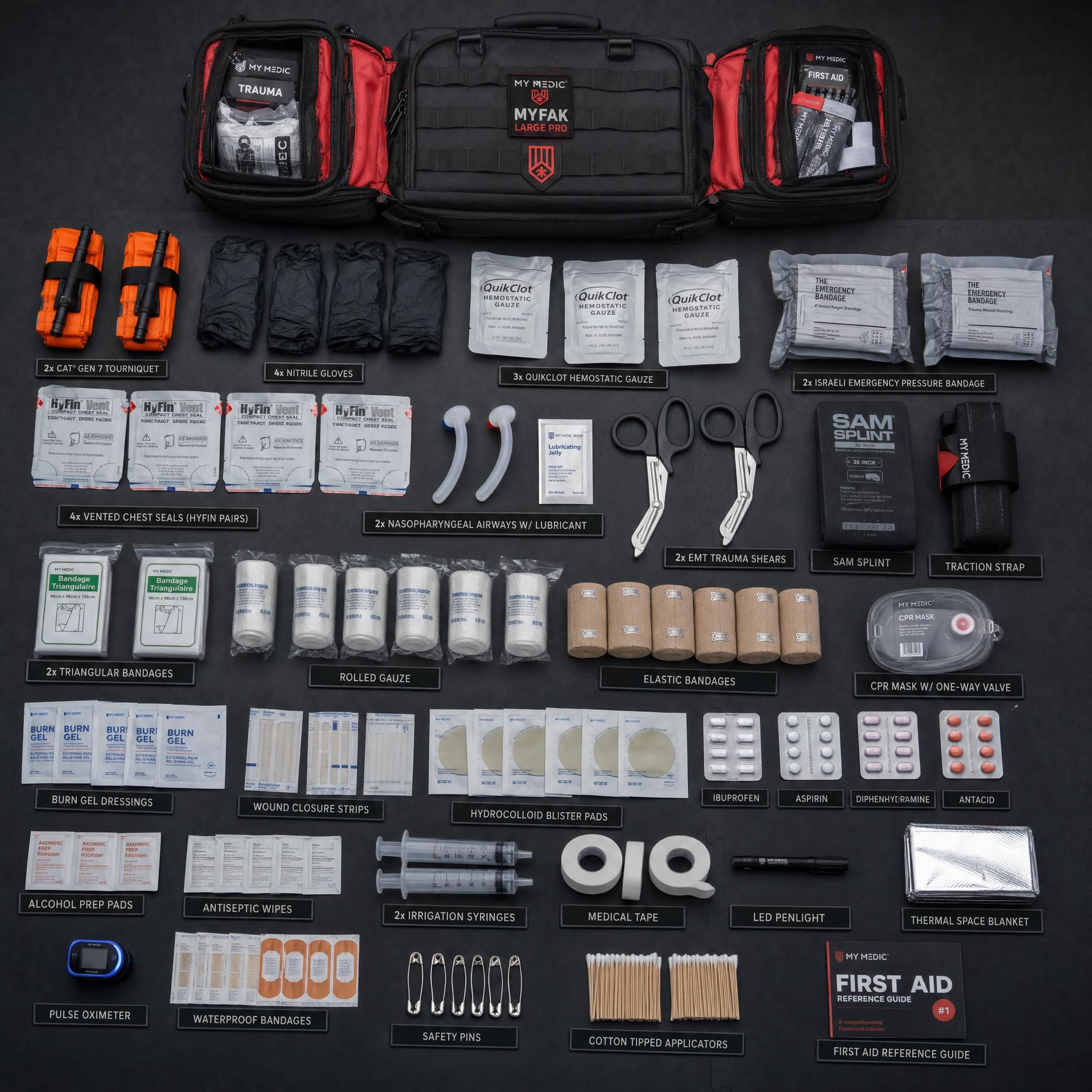
GEAR REVIEW: MyMedic MyFAK Large Pro Multi-Patient Medical Kit
The Collapse Ready Household Field Assessment — Tier 2: Family of Four, Multi-Day, Multi-Casualty
Retail Price: $424.95–$431.95 (MyMedic.com / Amazon)
Made in: USA
Weight: ~7.5 lbs (fully stocked)
Dimensions: 8.75″ W × 14″ H × 6″ D
Designed Capacity: 4–6 patients / multi-day sustained care
Warranty: Lifetime
HSA/FSA Eligible: Yes
Overview
When the standard MyFAK Pro ran out of room — and out of patient capacity — MyMedic built this. The MyFAK Large Pro is the step-change that serious preppers, homesteaders, remote workers, and Collapse Ready households need when “one kit, one patient” stops being a viable doctrine. At just under $432, it is the largest commercially available pre-built civilian trauma and extended-care kit with the MyMedic platform’s signature organization architecture. With 200+ individual items organized across an expanded multi-page folding system, this kit is explicitly designed for multi-user, multi-day scenarios where EMS is unavailable, delayed, or irrelevant.
This is not an everyday carry kit. This is the kit you reach for when the grid has failed, the roads are closed, and you are the only medic your family has.
The Bag & Platform
The MyFAK Large Pro rides in a 1000D nylon shell scaled roughly 40% larger than its Pro sibling. The bag’s footprint is substantial but storable — it fits in a standard kitchen cabinet shelf, a vehicle cargo area, or mounted to a heavy-duty MOLLE wall panel in a dedicated safe room or medical station. If you’re building a dedicated trauma station for your household, this bag + a mounted MOLLE panel is the recommended setup.
The expanded folding page system now features five organizational divider panels that fold fully open and stay rigid, creating a near-flat 28″ open workspace when fully deployed. This is not a trivial design upgrade — in a multi-patient scenario, speed of access across multiple casualties is where lives are lost or saved. The extra real estate means you’re not digging through a single-cavity bag while someone is actively bleeding.
Metal clasp hardware secures all panels. Same heavy-duty construction as the Pro series, field-verified through vehicle storage, drops, and thermal cycling by users in hunting, ranch, and emergency response contexts.
Tear-away MOLLE panel on the front face allows rapid field removal of the entire front pouch — functionally converting to a mini IFAK that can be rushed to a casualty while the main bag stays staged at your treatment position.
Contents — Full Multi-Patient Inventory
🩸 Hemorrhage Control — Multi-Casualty Configured
| Item | Qty | Notes |
|---|---|---|
| CAT Gen 7 Tourniquet | 2 | One per independent limb bleed across two patients simultaneously |
| QuikClot Combat Gauze (Hemostatic) | 3 rolls | Z-fold, 3″ × 4 yds each — covers simultaneous high-volume junctional bleeds |
| Israeli Emergency Pressure Bandage (4″) | 2 | One per patient for major wound management |
| Israeli Emergency Pressure Bandage (6″) | 1 | For high-volume bleeds: thigh, trunk, scalp |
| Elastic Bandage (3″, 4″) | 4 rolls | Multi-patient pressure dressing reinforcement |
| Plain Trauma Gauze | 4 rolls | Secondary wound packing material |
| Wound Closure Strips (1/4″ × 3″) | 40 strips | Laceration and incision closure |
| Medical Tape (cloth, 1″) | 2 rolls | High-adhesion, skin-safe |
| Nitrile Gloves (non-latex) | 4 pairs | Full PPE for simultaneous dual-patient treatment |
Multi-Patient Field Assessment: Two CAT Gen 7 tourniquets allow you to simultaneously manage one limb bleed on each of two casualties without improvising. Three rolls of QuikClot allows for either one catastrophic junctional bleed (groin, axilla, neck — which may require packing 1.5–2 full rolls) plus standard limb wound support, or three separate moderate-volume wounds across three patients. This is the correct math for a family-of-four scenario. Grade: A
🫁 Airway Management
| Item | Qty | Notes |
|---|---|---|
| Nasopharyngeal Airway (NPA), 28Fr | 2 | With lubricant; two unconscious patients served |
| NPA, 26Fr (pediatric-adjacent) | 1 | For smaller adults or adolescents |
| CPR Barrier Mask (one-way valve) | 1 | Full-face seal; significantly more effective than keychain shield |
| CPR Face Shield (backup) | 2 | Keychain style for immediate deploy |
Field Assessment: Two NPA tubes means two unconscious, spontaneously breathing patients can be maintained simultaneously without improvisation. The full-face CPR barrier mask is a notable upgrade over the keychain shields found in smaller kits — the seal quality and provider protection are meaningfully better. Absence of a bag-valve mask (BVM) remains a gap at this tier for households wanting ALS-adjacent airway capability — a BVM/AMBU bag costs ~$25 and is a priority add. Grade: B+
🩻 Chest Trauma
| Item | Qty | Notes |
|---|---|---|
| Hyfin Compact Chest Seal (vented, pair) | 2 packs (4 seals total) | Entry + exit coverage for TWO simultaneous penetrating chest wounds |
| 14-Gauge Needle Decompression Catheter | 1 | For tension pneumothorax — requires training; labeled prominently |
Field Assessment: Four chest seals is the correct load for a household kit. In a multi-victim shooting or blast scenario, chest wounds are frequently bilateral and frequently affect multiple victims. The 14-gauge needle decompression catheter is a significant clinical step up that does not appear in consumer kits at this tier. It requires training — this is a needle thoracostomy tool, and it should not be in this kit unless at least one household member has been trained in its use. If that’s you, it’s a life-saving capability. If not, leave it staged and labeled for a qualified responder. Grade: A
🦴 Musculoskeletal / Immobilization
| Item | Qty | Notes |
|---|---|---|
| SAM Splint (36″) | 2 | Wrist, forearm, ankle, lower leg — one per limb or two simultaneous patients |
| SAM Splint (18″, short form) | 1 | Finger, wrist, pediatric forearm |
| Triangular Bandage (sling) | 4 | With safety pins — sling, improvised tourniquet, pressure bandage, eye cover |
| Elastic Bandage (compression wrap) | 4 rolls | Splint wrap, joint compression, wound reinforcement |
| Traction Strap (improvised femur) | 1 | Basic traction assist for femur fracture — requires training |
Field Assessment: Two SAM splints enables true simultaneous dual-patient immobilization. The short-form SAM is an underappreciated inclusion for pediatric and finger injuries — broken fingers are among the most common structural injuries in disaster scenarios (debris, tools, falls). The traction strap is a limited but meaningful inclusion for femur fracture management; a dedicated traction splint (Sager or XTRAC) is the preferred tool but adds $60–$80 and significant bulk. For a mobile collapse kit, the strap is a reasonable compromise. Grade: B+
🔥 Burn Treatment
| Item | Qty | Notes |
|---|---|---|
| Burn Gel Dressing (4″ × 4″) | 3 | Cooling hydrogel for partial-thickness burns |
| Burn Gel Dressing (4″ × 16″, large) | 1 | Extended burn coverage (forearm, calf scale) |
| Sterile Non-Adherent Dressing | 6 | Secondary covering for burn wounds |
| Sterile Water Irrigation (60mL ampoule) | 2 | Eye wash and wound irrigation backup |
Field Assessment: The large-format burn dressing is a meaningful add over the Pro kit. Burns in collapse scenarios (cooking fires, fuel, electrical) are far more common than most preppers account for, and appropriate burn management for 24–72 hours requires adequate dressing supply. Three standard-format plus one large-format covers three minor burns simultaneously or one significant partial-thickness burn with dressing changes over 24–48 hours. Grade: A-
💊 Medications, OTC & Clinical Interventions
| Item | Qty | Notes |
|---|---|---|
| Aspirin (325mg) | 8 tabs | Cardiac event protocol — family of four with adults |
| Ibuprofen (200mg) | 16 tabs | 2-day pain/inflammation supply for 2 adults |
| Diphenhydramine / Benadryl (25mg) | 8 tabs | Allergic reaction — moderate severity |
| Antacid (calcium carbonate) | 8 tabs | GI support |
| Acetaminophen (500mg) | 10 tabs | Alternative to ibuprofen; fever reduction |
| Oral Rehydration Salts (ORS) | 4 packets | Critical for heat casualty, GI illness, or hemorrhage recovery |
| Glucose Tablets | 4 | Diabetic emergencies or severe caloric depletion |
| Nitrile Gloves | 4 pairs | PPE |
Field Assessment: The addition of acetaminophen and oral rehydration salts over the standard Pro kit is significant for multi-day extended care. ORS is one of the most important entries — dehydration from fluid loss, vomiting, diarrhea, or hemorrhage is a second-order killer in extended-care scenarios, and ORS is the established intervention short of IV fluids. Glucose tabs for diabetic emergencies in a family kit is appropriate and frequently overlooked. Epi-pen remains absent — same gap as the Pro, same urgency for at-risk household members. Grade: A-
🔬 Diagnostic & Extended Care Tools
| Item | Qty | Notes |
|---|---|---|
| Pulse Oximeter (fingertip) | 1 | SpO2 and pulse rate — critical for respiratory monitoring |
| Penlight (LED, medical grade) | 1 | Pupil assessment, wound inspection |
| Irrigation Syringe (35cc) | 2 | High-pressure wound irrigation (the 35cc is the clinical standard) |
| Wound Closure Kit (Steri-strips + benzoin) | 2 sets | Wound adhesive prep + closure strips |
| Scalpel (sterile, disposable, #22 blade) | 1 | Incision drainage, splinter removal — training required |
| Suture Kit (nylon, 3-0, with needle driver and forceps) | 1 | Wound closure in extended-care/delayed-evacuation scenarios |
| Cotton-Tipped Applicators | 20 | Wound cleaning, otoscope substitute, medication application |
| Hydrocolloid Blister Pads | 6 | High-use in extended movement/bug-out scenarios |
Field Assessment: The pulse oximeter, suture kit, and scalpel are the most significant tier-jump items over the Pro. The pulse oximeter gives you real-time SpO2 data that directly informs respiratory triage decisions — a patient dropping below 94% SpO2 needs airway intervention now, and you won’t know that without the tool. The 35cc irrigation syringe (vs the 20cc in the Pro) is clinically significant: 35cc delivers adequate wound irrigation pressure; 20cc is borderline.
The suture kit deserves its own note: suturing is a trained skill. In a collapse scenario where a physician-level responder is available, this is a life-changing inclusion. In untrained hands, sutured wounds that harbor infection are worse than open wounds managed with irrigation and wound closure strips. Train before you need it — cadaver labs, wilderness medicine courses, and suture training kits are all available. Grade: A
🔧 Tools & Accessories
| Item | Qty | Notes |
|---|---|---|
| EMT / Trauma Shears (7.25″) | 2 | One per active treatment position |
| Waterproof Bandages (assorted) | 30 | Knuckle, fingertip, standard — household daily use |
| Medical Tape (paper, 1″) | 2 rolls | Sensitive skin, dressing edges |
| Safety Pins (assorted) | 12 | Sling closures, dressing pins, improvised uses |
| Emergency Space Blanket | 2 | Thermal shock prevention, shock management |
| Chemical Cold Pack (instant) | 2 | Blunt trauma, sprains, heat reduction |
| Chemical Heat Pack | 2 | Hypothermia prevention, muscle relief |
| Antiseptic Wipes (BZK) | 20 | Wound prep and tool cleaning |
| Alcohol Prep Pads | 20 | Surface sterilization |
| First Aid Reference Guide (waterproof) | 1 | TCCC and civilian triage protocols |
| Permanent Marker | 1 | Patient tagging — mark tourniquet application time on skin |
| Triage Tags (START protocol) | 4 | Basic color-coded triage for mass casualty sorting |
Field Assessment: The permanent marker and START triage tags are two of the most clinically important items in the kit that get the least attention in reviews. In a multi-casualty event, you will not remember what time you applied a tourniquet without writing it on the patient’s skin. Tourniquet time directly governs limb salvage decisions — after 2 hours, the calculus changes dramatically. The START triage tags are a professional-grade addition that most household kits never include. Grade: A
Multi-Day Capability Assessment (72-Hour Horizon)
The MyFAK Large Pro is not a hospital. But it is a credible 48–72-hour medical station for a family of four across the most statistically likely collapse-scenario injury and illness categories:
| Scenario | Kit Capability | Gap |
|---|---|---|
| Traumatic hemorrhage (2 simultaneous) | ✅ Full — 2 tourniquets, 3 hemostatic gauze, 2 pressure bandages | None at this tier |
| Penetrating chest wound (2 simultaneous) | ✅ Full — 4 chest seals, needle decompression catheter | Requires trained user for decompression |
| Airway management (2 unconscious patients) | ✅ Adequate — 3 NPAs, full CPR mask | BVM missing; $25 add |
| Burns (minor to moderate) | ✅ Adequate — 3 standard + 1 large burn dressing | Not sufficient for major BSA burns |
| Fracture immobilization (2 simultaneous) | ✅ Adequate — 2 SAM splints + 4 triangular bandages | No dedicated traction splint |
| Laceration / wound care (multi-day) | ✅ Strong — suture kit, scalpel, irrigation, wound closures | Training required for suturing |
| Fever / pain (48-72 hrs) | ✅ Adequate — ibuprofen + acetaminophen supply | Limited to 2-3 day supply |
| Dehydration / fluid management | ✅ ORS included; no IV capability | IV fluids require prescription/training |
| Anaphylaxis (severe) | ❌ Gap — diphenhydramine only | Requires EpiPen prescription add |
| Diabetic emergency | ✅ Glucose tabs included | Limited quantity |
| Respiratory monitoring | ✅ Pulse oximeter included | No stethoscope at this tier |
Collapse Ready Assessment — What to Add for Full Capability
The MyFAK Large Pro is the best pre-built civilian kit in this price tier. For a fully mission-capable Collapse Ready Household station, add:
- BVM / AMBU Bag — Adult + pediatric mask — (~$25–$35) for full airway management capability
- EpiPen × 2 — Prescription; non-negotiable for any household member with known severe allergy
- Celox Granules (hemostatic, junctional) — For neck/groin/axilla bleeds where tourniquet placement is impossible (~$20)
- Sager or XTRAC Traction Splint — Femur fracture management (~$60–$80)
- Stethoscope (basic acoustic) — Lung assessment, blood pressure monitoring (~$20–$30)
- Blood Pressure Cuff (manual) — Shock progression monitoring (~$15–$20)
- Suture Training Kit — Practice on foam or pig’s foot before you need it on a person (~$25)
- Laminated Medication Reference Card — Dosing by weight for pediatric patients (free download, physician-reviewed sources)
- Pediatric NPA (20Fr) — If household includes children under 10 (~$8)
- IV Start Kit + Saline (250mL) — Prescription-adjacent; consider pursuing Wilderness First Responder (WFR) or Combat Medic training that includes IV skills
Total estimated add-on cost: $150–$200 for full-capability build-out
Pros and Cons
✅ PROS
- 200+ items across a genuinely multi-patient inventory — two tourniquets, three hemostatic gauze rolls, four chest seals, three NPAs, two sets of splints, and full PPE for concurrent dual-treatment
- Pulse oximeter included — one of the few consumer kits at any price that includes a diagnostic instrument; a non-negotiable tool for respiratory triage
- Suture kit and sterile scalpel included — elevates the kit to extended-care territory that no comparable pre-built kit under $500 provides
- Needle decompression catheter included — advanced life-safety capability for trained users in penetrating chest trauma; unavailable in any other consumer kit in this price range
- START triage tags and permanent marker — mission-critical multi-casualty tools, almost never included at this tier
- Oral rehydration salts — addresses the second-order killer in collapse medical scenarios that most kits completely ignore
- Expanded 5-panel folding page organization — the best consumer-grade organization system available, scaled for multi-patient workspace
- Tear-away MOLLE front pouch — converts to a deployable mini-IFAK while the main bag stays staged
- Lifetime warranty, USA made, HSA/FSA eligible — same ownership advantages as the smaller Pro
- Cold packs and heat packs — blunt trauma, hypothermia, and hyperthermia management included; frequently omitted in trauma-focused kits
- Acetaminophen + ibuprofen — dual pain management pathways for 48+ hours of multi-patient coverage
- Glucose tablets — diabetic emergency management in a family kit is uncommon and important
❌ CONS
- Price approaches the ceiling — at $425–$432, this is a deliberate, planned purchase, not an impulse buy; worth every cent but requires budget allocation
- No BVM / AMBU bag — a $25–$35 omission that leaves the airway management category incomplete at the ALS-adjacent level the rest of the kit implies
- No EpiPen — same gap as the Pro tier, same urgency; the diphenhydramine-to-anaphylaxis bridge fails in severe reactions
- No stethoscope or blood pressure cuff — the pulse oximeter is excellent, but BP monitoring for shock management remains an unclosed gap
- Suture kit and scalpel require training — including advanced clinical tools without training guidance in the kit materials creates risk for untrained users; the reference booklet helps but is not a substitute for hands-on instruction
- Needle decompression catheter is a liability without training — see above; label it prominently and stage it separately if no household member is qualified
- No IV fluids/start kit — appropriate for a consumer product (IV access is a trained clinical skill), but the gap is real for multi-day extended care scenarios
- No dedicated traction splint — the traction strap is a partial solution for femur fracture; a Sager or XTRAC is the correct tool and a recommended add
- Bag is not waterproof — same limitation as the Pro tier; high-humidity storage or flood-risk environments require additional protective measures
- Weight (~7.5 lbs) — this is a staged household/vehicle kit, not a pack-out kit; plan its location accordingly — it goes in the safe room or vehicle cargo, not on your back
- No pediatric-specific dosing guide — medication packets lack weight-based dosing; add a laminated pediatric reference card (free resources available from ACEP and AAP)
- Expiration tracking is owner-managed — same gap as the Pro; create an expiration log on day one and set annual inspection reminders
Final Verdict
Collapse Ready Rating: 4.6 / 5.0
The MyMedic MyFAK Large Pro at $424.95–$431.95 is, without qualification, the most capable pre-built multi-patient civilian medical kit available below $500. The jump from the Pro ($199–$249) to the Large Pro is not incremental — it is categorical. You gain a second tourniquet, a full extra patient’s worth of chest seals and hemostatic gauze, a pulse oximeter, a suture kit, a needle decompression catheter, START triage tags, oral rehydration salts, and a diagnostic-capable workspace. For a family of four in a collapse, bug-in, or extended grid-down scenario, the MyFAK Large Pro is the medical station your household’s safe room is built around.
Its gaps are manageable and known: add a BVM, a prescription EpiPen where warranted, and get trained. The MyFAK Large Pro gives you every tool the training is designed to use.
Purchase at: MyMedic.com | Amazon | Live Action Safety
⚠️ Collapse Ready Doctrine: The threshold for this kit is Wilderness First Responder (WFR) certification for at least one household adult, and Stop the Bleed + CPR for every other adult in the home. The suture kit, needle decompression catheter, and NPA become safe only when the hands holding them have practiced the skill. Budget the training hours alongside the purchase price — they are not separate costs, they are the same investment.
When Systems Fail — We Don’t.
Scherber 1st Responder Kit
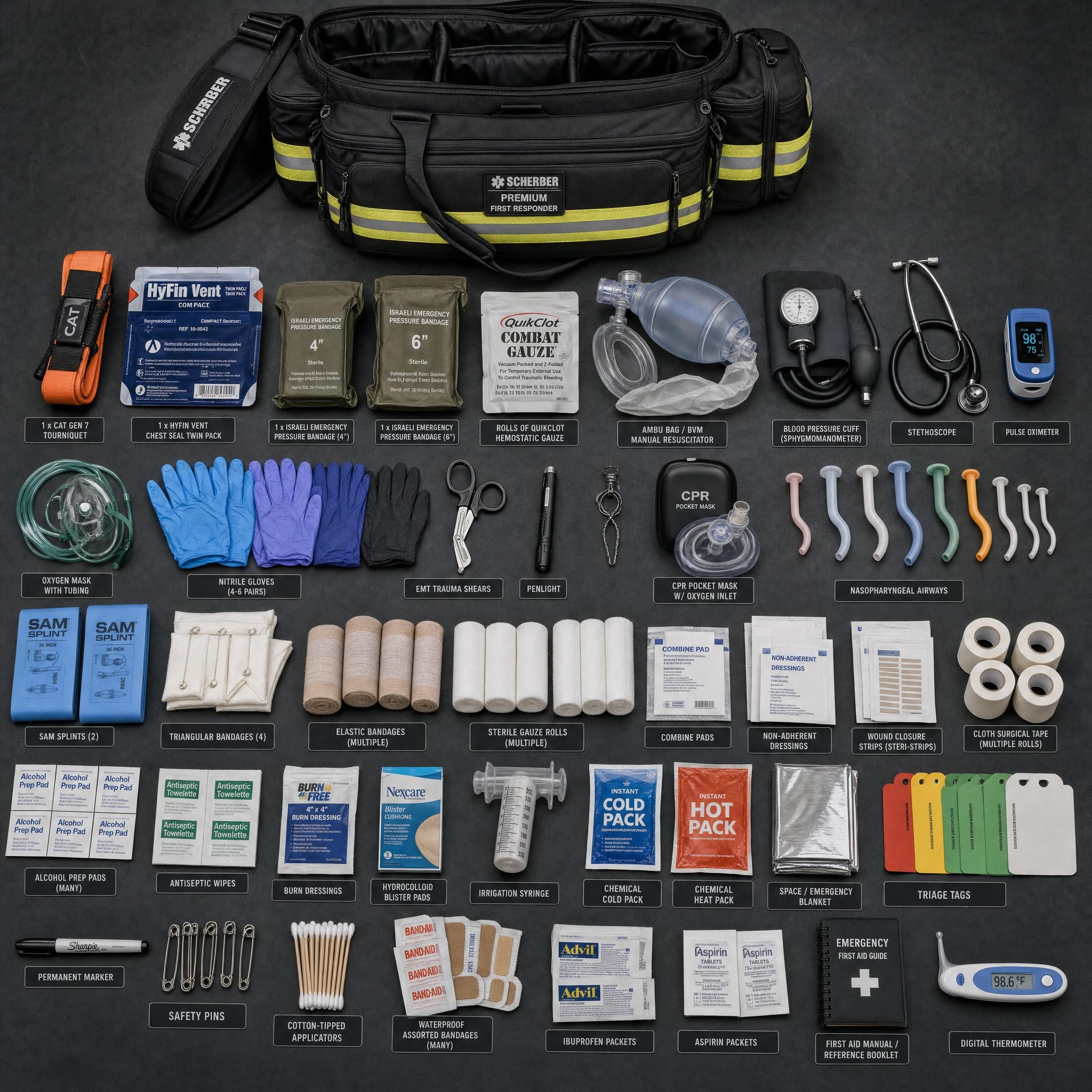
GEAR REVIEW: Scherber Fully-Stocked Premium First Responder Bag
The Collapse Ready Household Field Assessment — Tier 3: Professional-Grade Mobile Treatment Station
Retail Price: $459.99 (Amazon) | $329.99 (ScherberUSA.com — buy here)
ASIN: B0B9LMFZP3
Amazon Rating: 4.8 / 5.0 (34 verified reviews)
Supply Count: 250+ items across 51 categories
Bag Construction: 600D Water-Repellent Polyester, reinforced zippers, padded shoulder strap
Designed For: EMTs, Paramedics, Law Enforcement, Fire, Disaster Relief, Advanced Civilian Preparedness
Warranty: Lifetime (bag and hardware)
HSA/FSA Eligible: Yes
⚠️ Price Alert: The same kit is $130 cheaper direct from ScherberUSA.com. There is no functional difference between the Amazon and direct listings — buy direct, save the difference, and spend it on training.
Overview
This is not a first aid kit. It is not even a trauma kit in the traditional consumer sense. The Scherber Premium First Responder Bag is a fully staged mobile treatment station — the same category of bag that rides behind the seat of an ambulance, hangs on the wall of a fire station, or deploys from the trunk of a law enforcement supervisor’s vehicle. At $329.99 direct, it is the most accessible entry point into professional-grade pre-hospital medical capability available to the civilian market, and for the Collapse Ready Household operating in a long-term grid-down scenario, it represents an entirely different tier of readiness than anything reviewed in this series previously.
Where the MyFAK Pro handles one patient’s trauma and the MyFAK Large Pro extends that to a family of four, the Scherber bag puts a genuine first responder kit — stethoscope, blood pressure cuff, BVM airway management, oxygen capability, and 250+ supplies across 51 medical categories — into civilian hands. The gap this closes is not incremental. It is the difference between stabilizing a bleeding wound and actually managing a patient through a medical event over hours or days.
Fifty thousand Scherber kits have been sold. They are used by fire departments, EMS agencies, law enforcement, wilderness SAR teams, school districts, and businesses as their designated emergency response platform. That provenance matters. This is a workhorse bag with a real-world deployment record.
The Bag & Platform
The Scherber Premium ships in a large-format 600D water-repellent polyester shell — substantially bigger than anything in the MyMedic line — with reinforced double-stitched seams, heavy-gauge reinforced zippers, and a molded bottom panel that holds its shape when set down in the field. It is built to be thrown into vehicle trunks, dragged across pavement, and unzipped under stress by adrenaline-flooded hands. After 50,000 units in professional service, the hardware has earned its reputation.
The exterior features bright reflective striping — a non-trivial feature in collapse scenarios involving vehicle accidents, nighttime emergencies, or reduced-lighting environments. Most civilian kits are invisible in the dark. This one is not.
Carrying options: padded shoulder strap, top grab handle, and loop system compatible with standard gear mounting. The padded shoulder strap is a meaningful addition for anyone who has tried to lug a fully stocked bag across a parking lot, a field, or up stairs under urgency — the load distribution difference between a padded strap and a raw webbing handle is felt within the first 60 seconds of a real response.
Interior organization: Multiple zippered pockets — both interior and exterior — with a dedicated exterior quick-access panel for the most critical trauma items (tourniquet, chest seal, pressure bandage). The exterior oxygen access port is the detail that signals this bag is designed for professionals: the oxygen mask and tubing are reachable without opening the main compartment, which means airway support can begin while other supplies are still being organized. No consumer kit in this price range offers that architecture.
The one honest criticism of the platform — noted by r/TacticalMedicine users — is that the interior elastic net retention panels are lighter-duty than professional competitors like the NAR Aid Bag or Conterra packs. Items in netted pockets can shift during transport, particularly in vehicle applications where the bag sees repeated acceleration and braking. This is solvable: add a few bungee cord dividers or zip-tie loops to keep the interior organized to your preference, and it becomes a non-issue. It is a real observation, not a dealbreaker, and worth noting honestly.
Contents — Full Professional Inventory
The Scherber Premium covers 51 supply categories across every domain of pre-hospital care. Below is the breakdown by function.
🩸 Hemorrhage Control
| Item | Qty | Notes |
|---|---|---|
| CAT Gen 7 Tourniquet | 1 | TCCC-compliant windlass tourniquet; the gold standard |
| HyFin Vent Chest Seal (vented pair) | 1 pack (2 seals) | Entry + exit coverage for penetrating chest wounds |
| Israeli Emergency Pressure Bandage (4″) | 1 | Limb wound management |
| Israeli Emergency Pressure Bandage (6″) | 1 | High-volume wounds: thigh, scalp, trunk |
| QuikClot Hemostatic Gauze | 1–2 rolls | Z-fold, kaolin-impregnated; military-validated |
| Sterile Gauze Rolls (various) | 6–8 rolls | Wound packing and coverage |
| Combine/Abdominal Pads | 4 | High-absorption coverage for major wounds |
| Elastic Bandages | 4 rolls | Pressure reinforcement, splint wrap |
| Wound Closure Strips (Steri-strips) | 20+ | Laceration management |
| Medical Tape (cloth) | 2 rolls | High-adhesion dressing anchor |
| Nitrile Gloves (non-latex) | 4–6 pairs | Full PPE for multiple simultaneous providers |
Field Assessment: The CAT Gen 7 is the correct tourniquet at this tier — no controversy here, no RATS substitution. One CAT positions this kit as a single-patient trauma primary, but the depth of hemorrhage control supplies (multiple gauze rolls, two pressure bandages in different sizes, six+ sterile gauze rolls) means multi-patient hemorrhage management is achievable with what’s on hand. For a household of four, a second CAT is the first add-on purchase. Grade: A- (one CAT is the only gap at this clinical level)
🫁 Airway Management — The Tier-Defining Category
| Item | Qty | Notes |
|---|---|---|
| Ambu SPUR II BVM Manual Resuscitator | 1 | 1600mL adult bag-valve-mask with reservoir |
| CPR Pocket Mask with O2 Inlet | 1 | For spontaneous-breathing rescue breathing |
| Nasopharyngeal Airway (NPA) | 1–2 | Adjunct for unconscious but breathing patients |
| Oxygen Mask with Tubing | 1 | Non-rebreather mask; connects to supplemental O2 |
| CPR Face Shield (backup) | 2 | Keychain-style, single-use |
Field Assessment: This is the category that separates the Scherber from every kit in this review series. The Ambu SPUR II BVM is the genuine article — the same model used by EMTs and paramedics worldwide for positive-pressure ventilation of apneic (non-breathing) patients. A BVM allows you to breathe FOR a patient who has stopped breathing on their own. It is the single most important piece of airway equipment not found in any consumer kit under $400. Its inclusion here is not a box-check — it is the item that makes the difference between a patient surviving a respiratory arrest and not, in the minutes before advanced care can arrive (or in scenarios where advanced care is not coming). The O2 inlet on the CPR pocket mask — combined with the oxygen mask and tubing — means supplemental oxygen delivery is possible if you source a portable O2 cylinder (a ~$40 addition). Grade: A — first kit in this series to earn it in this category.
🩺 Diagnostics — Another Tier-Defining Category
| Item | Qty | Notes |
|---|---|---|
| Stethoscope (acoustic) | 1 | Lung sound auscultation, blood pressure assessment |
| Blood Pressure Cuff (manual sphygmomanometer) | 1 | Shock progression monitoring |
| Pulse Oximeter (fingertip) | 1 | SpO2 and pulse rate |
| Digital Thermometer | 1 | Fever, hypothermia, and sepsis monitoring |
| Penlight (LED) | 1 | Pupil assessment, wound inspection |
Field Assessment: Five diagnostic tools in a pre-built civilian kit. Read that again. The stethoscope + blood pressure cuff combination is the clinical backbone of patient assessment — without BP data, you are making medical decisions blind. A patient in compensated shock (still maintaining pressure through physiological compensation) looks relatively stable. A patient whose BP is dropping tells you something critically different. The Scherber is the first kit in this series that gives you the tools to know which patient you have. The digital thermometer closes the loop on extended-care fever management — a collapsing infection or sepsis secondary to a wound is a 24–72-hour threat, and temperature trending is how you detect it early. Grade: A
🩻 Chest Trauma
| Item | Qty | Notes |
|---|---|---|
| HyFin Vent Chest Seal (pair) | 2 seals | Vented — correct for penetrating thoracic wounds |
Field Assessment: One pair of vented chest seals covers one penetrating chest wound (entry + exit). For a multi-patient kit, this is the most immediate gap — add a second HyFin twin-pack (~$18) to cover a second simultaneous chest casualty. At this clinical tier, a needle decompression catheter (14ga) would be a logical add for trained users. Grade: B+ (single pair limits multi-patient coverage)
🔥 Burn Treatment
| Item | Qty | Notes |
|---|---|---|
| Burn Dressing (gel, standard format) | 2 | Cooling hydrogel for partial-thickness burns |
| Non-Adherent Sterile Dressings | 6 | Secondary burn covering |
| Sterile Water Ampoules | 2 | Eye and wound irrigation |
Field Assessment: Adequate for household burn scenarios. Not sufficient for significant BSA burn coverage — a large sterile burn sheet (~$8, Dynarex, available on ScherberUSA.com) is a recommended add for the Collapse Ready build-out. Grade: B
💊 Medications & OTC Interventions
| Item | Qty | Notes |
|---|---|---|
| Aspirin (325mg) | 4–8 tabs | Cardiac event protocol |
| Ibuprofen (200mg) | 8–16 tabs | Pain and inflammation |
| Diphenhydramine (25mg) | 4–8 tabs | Antihistamine — mild/moderate allergic reaction |
| Antacid tablets | 4–8 tabs | GI support |
| Ammonia Inhalant ampules | 2–4 | Syncope/fainting reversal — rapid consciousness recovery |
Field Assessment: The ammonia inhalant ampules are the standout addition over previous kits reviewed. Syncope (fainting) is among the most common non-traumatic collapse presentations in disaster scenarios — heat, shock, dehydration, anxiety — and a rapid-acting smelling salt reverses it in seconds. It is cheap, weightless, and frequently overlooked in civilian kits. Good call by Scherber to include them. Aspirin, ibuprofen, and diphenhydramine are present in appropriate quantities; EpiPen remains the prescription gap for anaphylaxis-at-risk households. Grade: B+
🦴 Musculoskeletal / Immobilization
| Item | Qty | Notes |
|---|---|---|
| SAM Splint (36″) | 2 | Forearm, wrist, ankle, lower leg |
| SAM Splint (18″) | 1 | Finger, wrist, pediatric |
| Triangular Bandages (sling) | 4 | Multi-use — sling, improvised tourniquet, eye cover |
| Elastic Bandages | 4 rolls | Splint wrap and compression |
Field Assessment: Solid multi-patient immobilization capability. Same assessment as the MyFAK Large Pro — a dedicated traction splint for femur fractures remains the gap at this tier. Grade: B+
🔧 Tools, Wound Care & Extended Care
| Item | Qty | Notes |
|---|---|---|
| EMT / Bandage Shears | 2 | For rapid clothing removal and dressing cuts |
| Irrigation Syringe (20–35cc) | 2 | High-pressure wound flushing |
| Safety Pins (assorted) | 12 | Sling closures, dressing management |
| Chemical Cold Pack (instant) | 2 | Blunt trauma, sprains, hyperthermia |
| Chemical Heat Pack | 2 | Hypothermia prevention, muscle management |
| Emergency Space Blanket | 2 | Thermal shock and hypothermia |
| Antiseptic Wipes (BZK) | 20 | Wound and tool prep |
| Alcohol Prep Pads | 20 | Surface sterilization |
| Waterproof Bandages (assorted) | 30+ | Knuckle, fingertip, strip — daily household use |
| Hydrocolloid Blister Pads | 6 | High-use in movement and bug-out scenarios |
| Cotton-Tipped Applicators | 20 | Wound cleaning, medication application |
| Permanent Marker | 1 | Tourniquet time notation on skin |
| Triage Tags (START protocol) | 4+ | Multi-casualty sorting |
| First Aid Reference Manual | 1 | Laminated or booklet format |
Field Assessment: Comprehensive. The dual cold/heat packs, triage tags, and permanent marker reflect professional EMS doctrine in a consumer kit. The addition of a stocked antiseptic spray bottle (Dynarex Antiseptic First Aid Spray — available as an add-on from ScherberUSA.com) is a recommended upgrade for extended wound management scenarios. Grade: A-
Scherber vs. the Previous Kits: Where It Stands
| Capability | MyFAK Pro ($199–$249) | MyFAK Large Pro ($425–$432) | Scherber Premium ($329–$460) |
|---|---|---|---|
| Tourniquet type | RATS (downgrade) | CAT Gen 7 ✅ | CAT Gen 7 ✅ |
| Chest seals | 2 (1 pair) | 4 (2 pairs) ✅ | 2 (1 pair) |
| BVM airway | ❌ | ❌ | ✅ Ambu SPUR II |
| Stethoscope | ❌ | ❌ | ✅ |
| Blood pressure cuff | ❌ | ❌ | ✅ |
| Pulse oximeter | ❌ | ✅ | ✅ |
| Thermometer | ❌ | ❌ | ✅ |
| Suture kit | ❌ | ✅ | ❌ |
| Needle decompression | ❌ | ✅ | ❌ |
| Triage tags | ❌ | ✅ | ✅ |
| Ammonia inhalants | ❌ | ❌ | ✅ |
| Oxygen mask/tubing | ❌ | ❌ | ✅ |
| Bag water resistance | ❌ | ❌ | ✅ (600D water-repellent) |
The headline takeaway: The Scherber is the only kit in this series with a BVM, stethoscope, and blood pressure cuff — the triad of tools that defines professional-grade patient management. The MyFAK Large Pro counters with a suture kit and needle decompression catheter that the Scherber lacks. The ideal Collapse Ready medical station pairs the Scherber bag as the diagnostic and airway platform with a supplementary wound-closure and advanced airway kit drawn from the MyFAK Large Pro’s unique contents.
Collapse Ready Assessment — What to Add for Full Capability
The Scherber Premium at $329.99 direct is an exceptional value at this capability level. For a fully mission-capable Collapse Ready Household treatment station, add:
- Second CAT Gen 7 Tourniquet — Multi-patient limb hemorrhage coverage (~$30)
- Second HyFin Vent Chest Seal Twin-Pack — Simultaneous bilateral chest wound coverage (~$18)
- Portable Oxygen Cylinder (size M6 or D) — The O2 mask is already included; the cylinder completes the system (~$40–$80 with regulator; refillable)
- 14-Gauge Needle Decompression Catheter — Tension pneumothorax capability for trained users (~$8–$15)
- Sterile Suture Kit + Scalpel — Extended wound closure for delayed-evacuation scenarios (~$20–$30)
- Large Burn Sheet (60″×90″) — Major BSA burn coverage (~$8, available from ScherberUSA.com)
- EpiPen × 2 — Prescription; anaphylaxis gap is present and critical
- Celox Granules (junctional hemostasis) — Neck, groin, axilla bleeds where tourniquet is impossible (~$20)
- Sager or XTRAC Traction Splint — Femur fracture management (~$60–$80)
- Pediatric NPA (20Fr) — For households with children under 10 (~$8)
Total estimated add-on cost: $200–$275 for full-capability professional build-out
Pros and Cons
✅ PROS
- BVM / Ambu SPUR II included — The single most important airway item absent from every other consumer kit under $400; its presence alone justifies the price tier over the competition
- Stethoscope + blood pressure cuff — The diagnostic triad (stethoscope, BP cuff, pulse ox) turns this from a treatment kit into a genuine patient assessment platform; no other pre-built civilian kit in this price range offers all three
- CAT Gen 7 tourniquet — The correct tourniquet, no RATS substitution, no argument
- HyFin Vent chest seals — The correct vented chest seal; two seals covers one penetrating wound properly (entry + exit)
- 600D water-repellent polyester construction — The first kit in this series with meaningful water resistance built into the bag itself; handles vehicle storage, rain, and field use without a cover layer
- Reflective striping — Visibility in nighttime or low-light emergency scenarios; absent from every consumer kit at lower tiers
- Exterior quick-access pocket — Critical trauma items (tourniquet, chest seal, pressure bandage) reachable without opening the main compartment
- Exterior O2 port — Oxygen mask access without bag disruption; professional EMS bag architecture
- Ammonia inhalant ampules — Syncope/fainting reversal; statistically common and almost never included in consumer kits
- Digital thermometer — Extended-care infection and sepsis monitoring; absent from most kits at any price
- Triage tags (START protocol) — Multi-casualty sorting capability; present in fewer than 10% of civilian kits regardless of price
- Lifetime warranty on bag and hardware — Professional durability commitment
- HSA/FSA eligible — Effective cost reduction for eligible households
- 50,000+ units in professional service — Proven field deployment record with EMS, fire, law enforcement, and SAR teams
- $329.99 direct vs. $459.99 Amazon — Significant savings for the identical product; buy from ScherberUSA.com
❌ CONS
- Only one CAT tourniquet — At this price and professional positioning, a second CAT should be included; a multi-patient kit with one windlass tourniquet is one patient over its design capacity for limb hemorrhage management
- Only one chest seal twin-pack (two seals) — Covers one penetrating chest wound; a second patient’s chest wound requires a supplemental purchase
- No suture kit or scalpel — The MyFAK Large Pro includes these; the Scherber does not; for extended-care wound closure this is a gap
- No needle decompression catheter — Also present in the MyFAK Large Pro; absent here; tension pneumothorax remains an advanced-care-only intervention without it
- Interior elastic net retention is lighter-duty than professional competitors — Verified community criticism; items can shift during vehicle transport; addressable with minor organization additions but a real construction gap versus NAR or Conterra bags at the professional price tier
- No EpiPen — Same prescription gap as every other kit in this series; households with anaphylaxis risk must source separately
- No portable oxygen cylinder — The O2 mask and tubing are included; the cylinder is not; this is a partially complete oxygen delivery system out of the box; add an M6 or D-size cylinder and regulator to complete it
- Amazon price is $459.99 vs. $329.99 direct — The $130 premium on Amazon adds nothing; this discrepancy is large enough to materially affect value assessment for buyers who don’t research before purchasing
- No pelvic binder — Same gap as previous kits; femur and pelvic fracture management requires an external add
- No IV start capability — Appropriate for a civilian product (IV access is a licensed clinical skill), but the gap from BVM/stethoscope/BP cuff capability to no fluid resuscitation ability is noticeable at this tier; households with a trained EMT or paramedic should add an IV kit and saline
Final Verdict
Collapse Ready Rating: 4.5 / 5.0
The Scherber Fully-Stocked Premium First Responder Bag at $329.99 direct is the kit that professional responders actually carry. The BVM, stethoscope, blood pressure cuff, and diagnostic toolset are not extras — they are the core of pre-hospital patient management, and this is the only consumer kit in the sub-$500 tier that includes all of them. For a Collapse Ready Household in which at least one adult has completed an EMT-Basic course, a Wilderness First Responder certification, or equivalent training, this bag is the operational centerpiece of your medical station. Everything else — the MyFAK Pro for vehicles, the MyFAK Large Pro for the safe room — supports this bag, not the other way around.
Its gaps are real but known and fixable: add a second CAT, a second chest seal pack, a suture kit, and an oxygen cylinder. The internal net retention panels are lighter than professional alternatives — address it with bungee loops or elastic cord and move on. The bag itself, the hardware, and the clinical toolset are professional-grade and field-proven.
Buy direct. Train to the equipment. This is the kit your household’s medical station is built around.
Purchase at: ScherberUSA.com ($329.99 — recommended) | Amazon ($459.99)
⚠️ Collapse Ready Doctrine: The Scherber’s diagnostic suite — stethoscope, blood pressure cuff, pulse oximeter, thermometer, and BVM — is only as useful as the person holding it. This kit’s true capability tier begins at Wilderness First Responder (WFR) or EMT-Basic certification. If you purchase this kit without that training, you are staging a tool you cannot fully use. Enroll in a WFR course (typically 70–80 hours over one week), then return to this bag and it will transform in your hands. The equipment is ready. The question is whether you are.
When Systems Fail — We Don’t.
The Stories Podcast is sponsored by
Explore the episodes
Podcast